East Asia Bitumen Market
East Asia Bitumen Market: Buyers Are Becoming More Selective
East Asia’s bitumen market is now driven by execution, not just price.

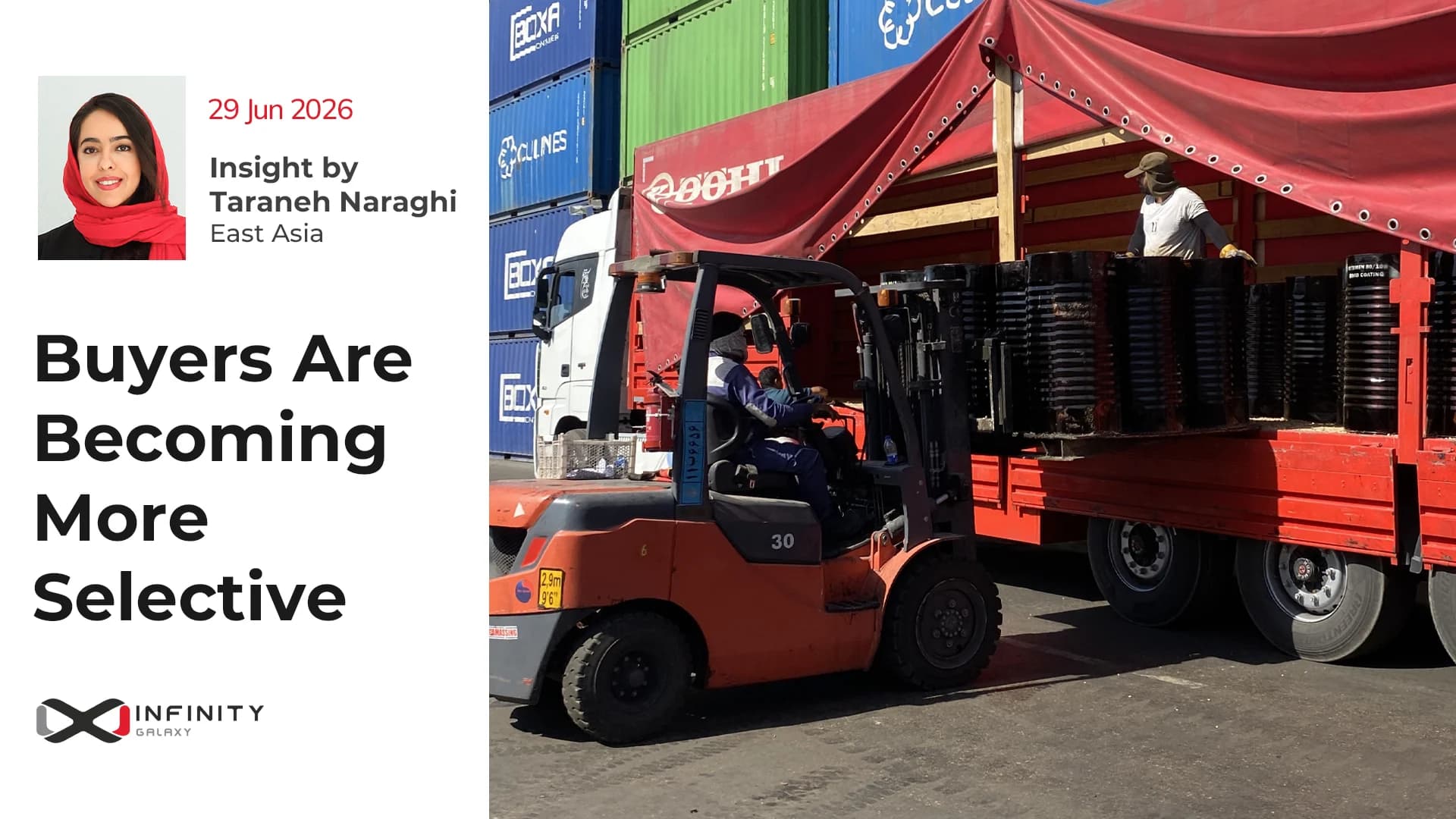
After the latest developments around the Strait of Hormuz, East Asian buyers are still watching whether feedstock supply and shipping confidence can fully normalize. For now, the market is not moving only by price. Origin, loading schedule, and execution reliability matter more.
The East Asia bitumen market stayed firm in late June, but buying activity remained selective. Offers from key origins were still high, while buyers resisted premium levels unless the deal was commercially workable..
Singapore, Benchmark Market Faces Resistance
Singapore remains the main benchmark for East Asia bitumen prices. Export offers moved slightly higher, but buyers resisted premium levels.
Most July-loading cargoes were already committed, while August supply remains unclear. Sellers were targeting above USD 610/MT FOB Singapore, while bids were mostly around USD 600–605/MT FOB.
Singapore is still the reference market, but not always the most practical origin for every buyer.
Malaysia, Demand Is Slowly Returning
Malaysia showed modest improvement after infrastructure funding was released, but rainfall in Kuala Lumpur, Selangor, and Penang continued to slow roadwork.
Tank truck export prices from Singapore to Malaysia were around USD 640–650/MT Ex-Refinery. Supply was enough for current demand, but stronger activity may appear if projects accelerate next month.
Malaysia is no longer inactive. It is preparing for stronger demand.
Indonesia, Low Inventories, Patient Buyers
Indonesia stayed slow outside Java and Sumatra. Some terminals had low inventories, but high seaborne prices, freight costs, and the weaker Rupiah kept buyers cautious.
Most workable buying levels were around USD 640/MT CFR. Buyers are still waiting for possible further price pressure from softer crude oil.
Indonesia has potential, but timing is the key.
Thailand, Alternative Origin Gains Attention
Thailand became more important as export availability tightened and most July-loading cargoes were already allocated.
One Asia-Pacific cargo was reported around USD 590–600/MT FOB Thailand. Sellers remained above USD 600/MT FOB, while some buyers reduced bids below USD 580/MT FOB.
For some Southeast Asian destinations, Thailand is becoming a more practical alternative to Singapore.
Vietnam, Selective Buying Returns
Vietnam saw slightly better buying interest as drier weather helped construction activity restart.
Singapore-origin cargoes remained expensive for Vietnamese buyers, so interest shifted toward Thai and Chinese cargoes. Buying indications for July-loading cargoes were around USD 630–640/MT CFR North and South Vietnam, mainly for urgent projects.
Vietnam has demand, but only for the right origin and realistic price.
South Korea, Lower Tender Improves Competitiveness
South Korea gave one of the strongest signals this week. After the latest Yeosu tender, July-loading cargoes were reportedly concluded around USD 525–530/MT FOB South Korea.
This improved South Korea’s competitiveness for Chinese buyers. However, weaker Chinese domestic sentiment later pushed bids lower.
South Korea can quickly influence regional direction when tender levels move.
China, Domestic Weakness Pressures the Region
China remains the key pricing driver in East Asia, but domestic sentiment weakened. Prices in Shandong, East China, and South China softened as rainfall, weaker energy markets, and expectations of further declines kept buyers cautious.
Shandong ex-works prices declined to around RMB 4,170–4,650/MT. Buyers mostly purchased only for immediate needs.
If Iranian crude availability improves, Chinese refinery production may gradually recover in the coming weeks. This could reduce import demand and add more pressure to regional bitumen prices.
Insight by Taraneh Naraghi from Infinity galaxy
East Asia’s bitumen market is now driven by execution, not just price.
- Singapore remains the benchmark, but buyers resist higher levels.
- Malaysia is gradually recovering.
- Indonesia is waiting despite low inventories.
- Thailand is gaining value as an alternative origin.
- Vietnam is buying selectively.
- South Korea has become more competitive.
- China’s weaker domestic market may continue to pressure regional prices.
The best bitumen deals this week are not necessarily the cheapest ones. They are the deals with the right origin, workable price, reliable loading schedule, and real execution capability.
Contact with Taraneh
Send a message on WhatsApp to receive further information.

Comments
Share your thoughts...
More Reports
Curious to see more, discover more articles, and stay up-to-date?