Bitumen
Weekly Bitumen Report: Brent Oil Price Falls, but the Bitumen Market is Still Dependent on Other Factors
Diplomacy Advances, but Key Disagreements Remain As of Thursday, June 25, the global energy market was receiving two conflicting signals. The first round of US-Iran negotiations in Switzerland, attended by Pakistan and Qatar, concluded with a 60-day roadmap and an agreement to continue technical discussions. However, disagreements over nuclear inspections, unfrozen Iranian assets, and the...

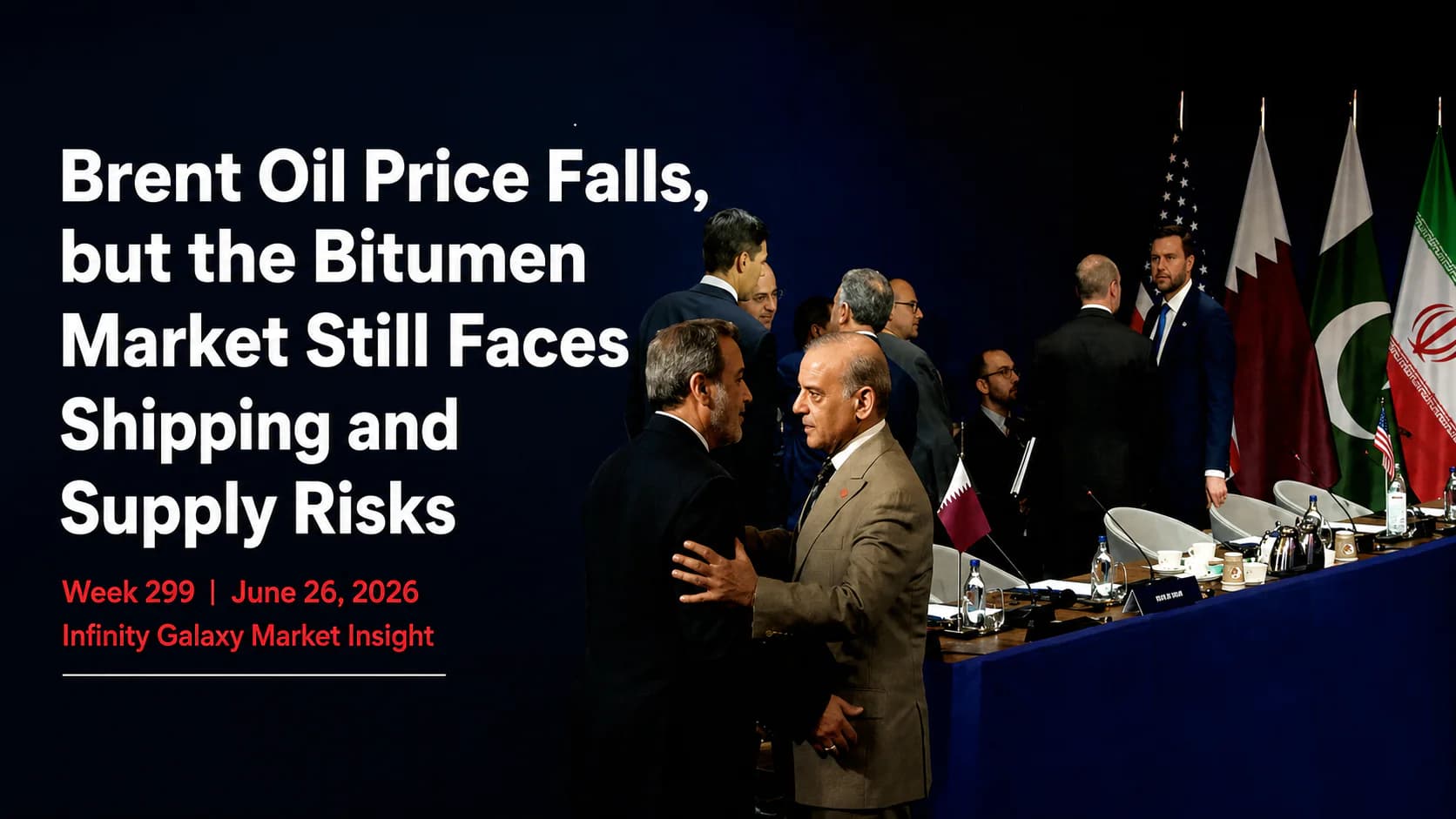
Diplomacy Advances, but Key Disagreements Remain
As of Thursday, June 25, the global energy market was receiving two conflicting signals. The first round of US-Iran negotiations in Switzerland, attended by Pakistan and Qatar, concluded with a 60-day roadmap and an agreement to continue technical discussions. However, disagreements over nuclear inspections, unfrozen Iranian assets, and the terms of a final settlement remained unresolved. The Iranian president’s visit to Pakistan also strengthened Islamabad’s position as a key diplomatic channel between Tehran and Washington.
The most important economic outcome was a temporary 60-day US general license authorizing the sale of Iranian crude oil, petroleum products, and petrochemicals. In Lebanon, the ceasefire has largely held, although sporadic clashes and disagreements over the withdrawal of Israeli forces show that geopolitical and Middle East shipping risks have not completely disappeared.
Brent Oil Price Loses Much of Its War Premium
Progress in the negotiations, temporary sanctions relief for Iranian oil, and the gradual departure of tankers from the Strait of Hormuz removed a significant part of the war premium from oil prices.
Brent crude traded between approximately USD 77 and USD 83 per barrel from June 13 to June 19. By the close of trading on June 24, the Brent oil price had fallen to around USD 74 per barrel, its lowest closing level since February 27, before the war began. The market is now paying greater attention to the actual return of Iranian oil and delayed Persian Gulf cargoes than to political statements alone.
Hormuz Strait Reopens, but Shipping Is Not Yet Normal
Lower crude oil prices do not mean that shipping conditions have returned to normal. Several tankers carrying about five million barrels of oil have exited the Hormuz Strait since the agreement. At the same time, an International Maritime Organization program has begun facilitating the gradual departure of hundreds of stranded vessels.
Nevertheless, daily vessel traffic remains well below pre-war levels, and many tankers and commercial ships are still waiting inside the Persian Gulf. Limited vessel availability, high freight rates, war-risk insurance, and port congestion continue to prevent a rapid decline in delivered bitumen prices.
Singapore Bitumen Holds Firm as HSFO Prices Fall
In East Asia, Singapore HSFO prices fell sharply as crude oil declined and regional supply flows improved. HSFO 180 CST dropped to approximately USD 446 per metric ton, while HSFO 380 CST reached around USD 436 per metric ton.
However, the Singapore bitumen price remained close to USD 556 per metric ton, while South Korean bitumen was assessed at approximately USD 486 per metric ton. This divergence shows that the bitumen market is still responding more strongly to limited physical supply, production delays, and restricted cargo availability than to the decline in crude oil and fuel oil prices.
China Bitumen Buyers Remain Cautious
In China, lower crude oil prices, seasonal rainfall, limited road construction activity, and expectations of further price reductions have weakened buying interest.
However, limited export availability from South Korea and reduced supply from refineries in southern China continue to prevent a rapid decline in the regional bitumen price. Buyers are therefore waiting for clearer evidence of lower replacement costs before returning to the market.
India: High Domestic Prices, Cautious Importers
Limited supply has caused a significant increase in domestic bulk bitumen prices in India. At the same time, the monsoon season, high tanker freight rates, and expectations that previously ordered Persian Gulf cargoes will arrive have encouraged buyers to delay new purchases.
European Bitumen Prices Decline, while Bahrain Remains Stable
In Europe, the sharp correction in Brent crude and HSFO reduced export cargo values. The overall European bitumen price range declined to approximately USD 460-495 per metric ton.
Bahrain bitumen remained unchanged at around USD 550 per metric ton, while export activity continued to be limited.
Iran Bitumen FOB Prices Fall, but Freight Costs Remain Extremely High
After several months of disruption, the Iran bitumen price for drummed cargoes was assessed at approximately USD 420-435 per metric ton FOB.
The main challenge is no longer the FOB price alone. Ocean freight costs on several routes are currently around four to five times higher than before the war. As a result, delivered offers from Iran remain expensive despite the decline in FOB bitumen prices.
Outlook: The Oil Market Is Moving Faster than the Physical Bitumen Market
As of June 25, Brent crude had surrendered a large part of its wartime gains, but the global bitumen market had not yet returned to normal.
If stranded vessels continue to move, crude feedstock returns to Asian refineries and freight rates decline, lower Brent and HSFO prices will gradually place downward pressure on bitumen prices. For now, however, the market’s most important variables are not limited to the oil price. Actual loading schedules, vessel availability, and ocean freight costs remain equally important.
Insight from Razieh Gilani at Infinity Galaxy
In a volatile bitumen market, a good price is not simply the lowest number. It is a price at which the product can genuinely be produced, shipped, and delivered.
A supplier’s credibility becomes clear when market conditions change, and the seller remains available, responsive, and accountable.
Contact with Razieh
Send a message on WhatsApp to receive further information.

Comments
Share your thoughts...
More Reports
Curious to see more, discover more articles, and stay up-to-date?