Bitumen
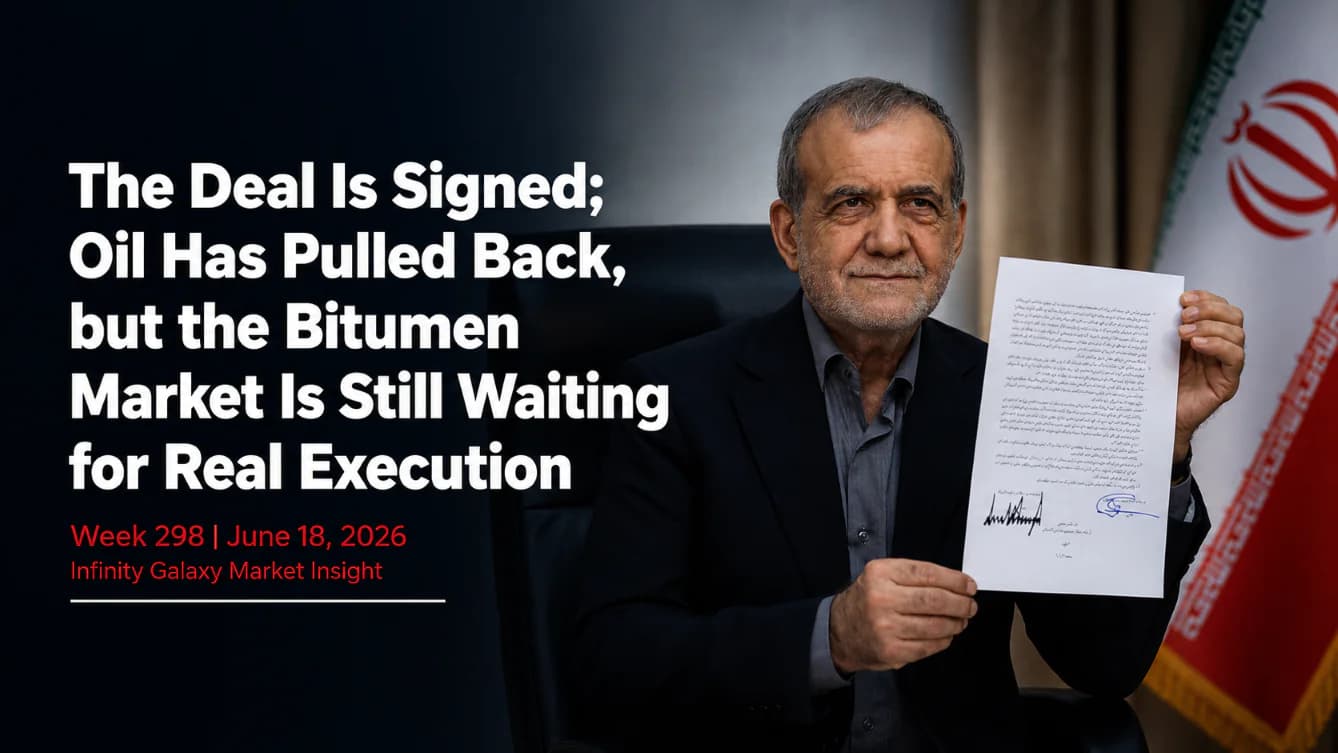
Weekly Bitumen Report: The Deal Is Signed; Oil Has Pulled Back, but the Bitumen Market Is Still Waiting for Real Execution
Political and Energy Phase The market opened this week with a major shift: after more than three months of war and tension in the Persian Gulf, the U.S. and Iran reached a temporary ceasefire framework and interim understanding. The political message was clear: the path of war has been paused for now, and a 60-day...

Political and Energy Phase
The market opened this week with a major shift: after more than three months of war and tension in the Persian Gulf, the U.S. and Iran reached a temporary ceasefire framework and interim understanding. The political message was clear: the path of war has been paused for now, and a 60-day negotiation window has opened. But for the market, the signature itself is only the beginning. The real question is whether this agreement can bring back actual shipping activity, buyer confidence, and normal energy flows.
At the G7 summit, the market was focused on the same issue: lower geopolitical risk, the gradual reopening of the Hormuz Strait, and the possibility of part of Iran’s supply returning to the global market. Trump has spoken about lifting the blockade around the Hormuz Strait quickly, but energy-market sources are still treating this with caution. The experience of the past few months has shown that reopening a route on paper is not the same as normal behavior returning among shipowners, insurers, refiners, and buyers.
Brent Oil Price
On Thursday morning, after news of the agreement being signed, Brent Oil Price moved down to around $77 per barrel, and the market removed a large part of the war premium. This drop shows that traders have started to price in the gradual return of energy flows through the Hormuz Strait and lower geopolitical tension. However, Brent has not fully entered a calm phase yet, because the details of execution, the timeline for shipping normalization, and the behavior of regional parties are still not clear to the market.
From Oil to Bitumen: Lower Risk, Not Full Normalization
For the bitumen market, the new agreement is a positive signal, but it does not immediately solve the supply chain. If the Hormuz Strait is truly reopened, the psychological pressure on shipping, insurance, and feedstock will ease. But the return of loading schedules, port clearance in the Middle East, and buyer confidence will take time. This is why the bitumen market has entered a two-sided phase: expectations are improving, but an executable deal is still more important than the quoted price.
East Asia: Singapore Held High, South Korea Softened, China Remained Cautious
In East Asia, new data shows Singapore 180 CST fuel oil at around $466 per ton by 17 June, while Persian Gulf 180 CST fuel oil was around $445 per ton. This means oil products have lost part of their previous pressure after the agreement. In China, despite higher regional price levels, aggressive buying has not returned yet. Rainfall, limited liquidity, and project-side caution are still preventing demand from opening quickly.
India: The Short Correction Ended, and the New Increase Returned
In India, refiners raised VG30 prices by around $30 per ton and VG40 prices by around $34 per ton from 16 June. This means the limited correction seen at the beginning of June did not last, and the Indian market has not entered a cheap phase. It has only moved from the previous shock into a more active and more sensitive pricing phase.
Bitumen Price in Europe and Bahrain
In Europe, international reports show export prices moving in the range of around $540 to $570 per ton. Europe has become cheaper, but because of supply limitations and refinery maintenance, the market is not fully weak yet.
Bahrain bitumen also remains stable at around $550 per ton in the latest data.
Iran Bitumen Price
In Iran, drum bitumen prices are moving around $445 to $455 per ton. But the main issue is still not the price; it is shipping routes, vessel access, and the real ability to execute exports. From Saturday, 20 June 2026, the market should watch for new shipping programs for export cargoes.
Market Summary
The market has moved away from the war-shock phase, but it has not entered a normal phase yet. Oil reacted faster than bitumen to the agreement because the oil market trades on expectations, while bitumen depends on execution. Singapore is still supported by limited supply, Korea and India are each moving on their own path, China remains cautious, Europe has corrected, and Iran is now at a sensitive point for the practical return of exports. From this point forward, the market will pay less attention to political statements and more attention to execution signals: vessels, insurance, loading, payment, and delivery.
Razieh Gilani from Infinity Galaxy
In these conditions, the biggest mistake is for a buyer to think that once an agreement is signed, everything returns to normal on the same day. The market now needs suppliers who understand the news correctly, do not rush to quote prices, and remain available when conditions change. A good price is not just the lower number; a good price is a number backed by execution capability, fast response, and honest risk explanation. In a market moving from war toward agreement, trust becomes more important than the price itself.

Comments
Share your thoughts...
More Reports
Curious to see more, discover more articles, and stay up-to-date?