


Weekly Bitumen Report: The Ceasefire Has Been Extended, but Oil Price and Bitumen Price Remain Under the Shadow of the Strait of Hormuz
Political Signal and Oil Price
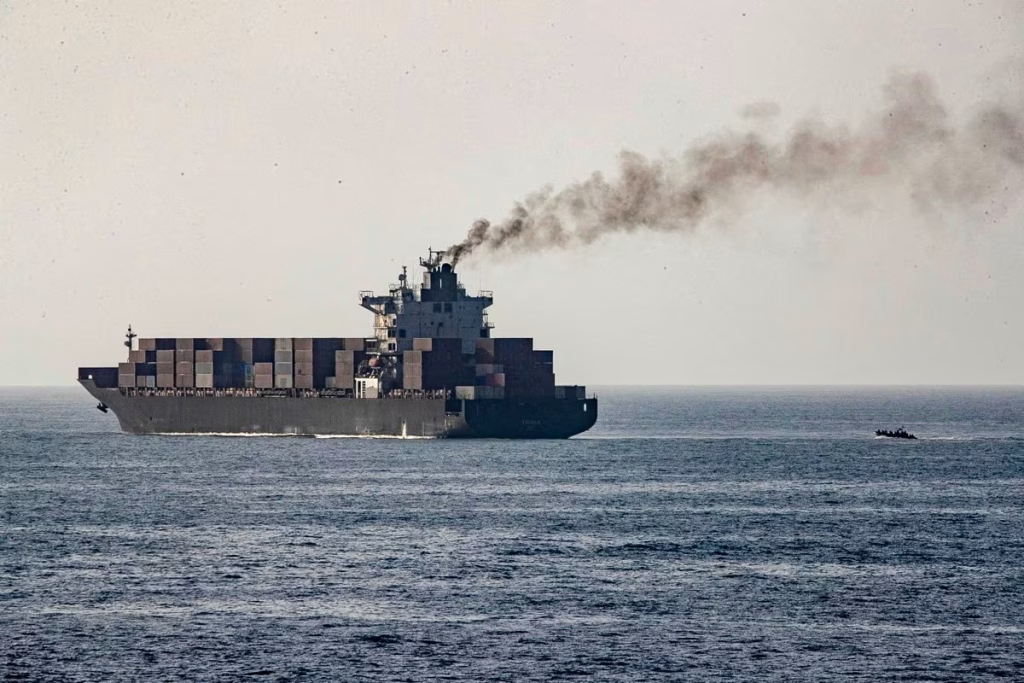
As of 23 April 2026, the most important development is that the ceasefire between Iran and the United States has been extended, but the market still does not view it as the end of the crisis. The reason is clear: the negotiations have stalled, and the next round of talks remains within the diplomatic track without any final outcome being announced. At the same time, the threat of renewed conflict in the coming days has not been removed, and that is why the extension of the ceasefire has not had a fully calming effect on the market. In the Strait of Hormuz, conditions have again become more difficult. Limited passage for some vessels became possible for a short period, but Iran has once again imposed restrictions, while the United States has maintained naval pressure and the seizure of Iran-linked vessels. The message for the market is clear: the Strait of Hormuz has still not returned to normal, and shipping risk, insurance costs, and delivery uncertainty remain high.
Brent crude oil moved back above $100 during the past week and was trading around $103 by 23 April, as the market continues to price in shipping disruption, halted tankers, and slow progress in negotiations alongside the ceasefire extension. In US financial markets, conditions have become calmer compared with the peak of the war, but they are still not fully stable, and investors continue to react quickly to energy and Middle East headlines. The impact of the war has not been limited to oil. The fertilizer market and even global food security have also come under pressure, because disruption in energy and shipping has raised the cost of producing and moving agricultural inputs.
Bitumen Price: From Politics to the Real Market
In the fuel oil and bitumen price markets, the sharp decline seen last week has stopped, but the market remains cautious. The latest data shows that by 21 April, Singapore HSFO 180 had reached around $626 per ton, while Persian Gulf HSFO 180 was around $556 per ton. In other words, part of the war shock has been absorbed by the oil products market, but full normalization is still far away. In bitumen, the latest weekly assessment shows Singapore at around $660–670 per ton and South Korea at around $547–557 per ton. In China, demand is high but still cautious and mostly limited to essential purchases. In India, the main signal has been that after two unprecedented rounds of price increases in April, the market is not expecting any decline at all, and conditions now appear to be highly favorable for importers. In Europe, despite a retreat from the March peak, export levels are still high and continue to move mainly in the range of around $560–590 per ton across the continent.
In Iran, the issue is still not only price. The main problem remains the actual execution of exports. Even with the ceasefire extension, the Strait of Hormuz is still closed, shipping lines are refusing to provide bookings, and this is exactly where the difference between an attractive offer and an executable offer becomes clear for a professional buyer. Delivery times remain uncertain, prices are still very high, and less informed buyers can easily run into serious problems.
Razieh Gilani from Infinity Galaxy:
In a market like this, what matters is not only who gives a price quickly. What matters is who gives the right price, who has real credibility, who does not make unrealistic delivery promises in these conditions, and who remains genuinely available and responsive while the market is changing every day. Right now, many can quote a number, but turning that number into a workable export process under current conditions has become much harder. In a market where oil price, bitumen price, and the Strait of Hormuz affect buying decisions every day, a professional buyer needs more than ever to understand the difference between a “low price” and an “executable price.”
At Infinity Galaxy, the real value is not only in staying informed. It is in watching the market every day, understanding the real conditions, and standing beside the customer when a real decision has to be made.
Recent Reports


Recent Reports

East Asia Bitumen Market: From Price Shock to Strategic Buying in April 2026
 Taraneh Naraghi

Weekly Bitumen Report: Ceasefire Continues, the Strait of Hormuz Remains Closed, and Bitumen Prices Stay Elevated
 Razieh Gilani