Market Analysis
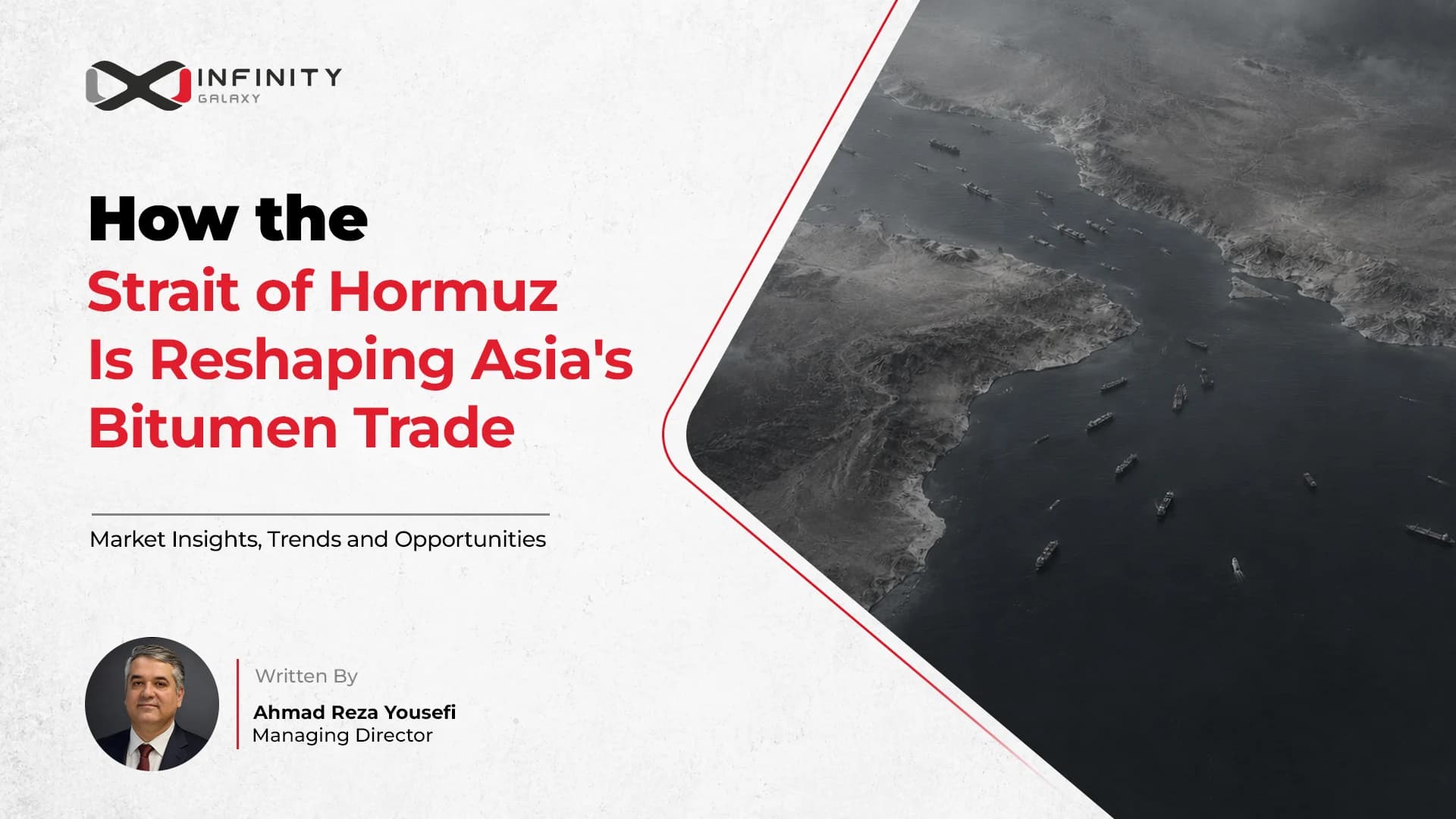
How the Strait of Hormuz Is Reshaping Asia's Bitumen Trade
Iran is still the lowest-priced major origin, but restricted shipping has changed what 'competitive' means. South Korea, Singapore and China are filling parts of the gap - at a higher cost.

- Key Takeaways
- How the Market Changed in Three Phases
- Phase 1: A broad regional price shock
- Phase 2: Crude eased, but shipping did not normalize
- Phase 3: Execution risk became the real benchmark
- Which Origins Can Replace Iranian Bitumen ?
- Singapore: A Scarcity Price, Not a Demand Boom
- South Korea: The Most Executable Partial Substitute
- China and India: Two Different Responses
- Why Cheaper Iranian Bitumen Is Not Always More Competitive
- So, Who Has Replaced Iran?
- What Buyers Should Watch Next
- Frequently Asked Questions
- Can South Korea fully replace Iranian bitumen?
- Why is Singapore bitumen so expensive?
- Why did Iranian bitumen prices fall during higher geopolitical risk?
- Could China become a permanent bitumen exporter?
- What would signal a real recovery in Iranian exports?
Iran is still the lowest-priced major origin, but restricted shipping has changed what 'competitive' means. South Korea, Singapore and China are filling parts of the gap - at a higher cost.
The Strait of Hormuz crisis has not removed Iran from Asia's bitumen map. It has changed how buyers define value. By mid-August, Iranian bitumen exports remained constrained by the maritime blockade, while Asian buyers increasingly compared cargo availability, loading schedules and delivery certainty alongside FOB prices.
The outcome is not a clean replacement of Iran by one country. It is a more expensive multi-origin system: Singapore carries a scarcity premium, South Korea provides a more executable alternative, China exports opportunistically, and India relies more heavily on domestic refineries when imported cargoes become difficult to deliver
Key Takeaways
- No single country has replaced Iran in the Asian bitumen market.
- Singapore moved from roughly $360/t in February to around $620/t by August, mainly because of tight supply rather than strong demand.
- South Korea became the most balanced substitute on price and execution, but its export capacity and grade flexibility are limited.
- Iranian quoted prices fell sharply, yet freight, insurance, delays and uncertain loading reduced their commercial value.
How the Market Changed in Three Phases
Phase 1: A broad regional price shock
On 20 February, Singapore export bitumen was assessed at $355-365/t, South Korea at $365-370/t and the Mediterranean at about $364-369/t. East China stood at $395-410/t CFR, while Mumbai bulk prices were $553-588/t. Price gaps between major Asian origins were still manageable.
By 5 June, Singapore had climbed to $585-590/t, South Korea to $550-560/t and East China to $590-600/t CFR. Mediterranean values reached about $576-580/t, while Mumbai rose to $777-840/t. Several markets had gained more than 50% in less than four months.
Phase 2: Crude eased, but shipping did not normalize
A temporary political understanding reduced the war premium and brought Brent back toward $72/bl in early July. Physical bitumen trade, however, did not recover at the same speed. The passage of a few vessels was not enough to restore predictable loading, insurance and delivery schedules.
Phase 3: Execution risk became the real benchmark
After the interim arrangement ended, shipping risk returned as the first market variable. By 10 July, Singapore was $605-615/t, South Korea $515-529/t and the low end of Persian Gulf assessments near $328/t. The roughly $280/t spread was not a quality gap; it was the market price of deliverability.
The next escalation restricted safe passage through the Strait of Hormuz and lifted freight, war-risk insurance and delay exposure. By 23 July, traffic had fallen close to zero while Brent moved above $96. At the end of July, Singapore was $619-630/t, South Korea $525-545/t and East China $560-580/t.
Even when Brent later fell toward $79, bitumen prices resisted the decline because regular vessel traffic and reliable loading schedules had not returned.
Which Origins Can Replace Iranian Bitumen?
| Origin | Market Role | Main Advantage | Main Constraint |
|---|---|---|---|
| Singapore | Scarcity benchmark | Reliable regional hub | High price; limited spot supply |
| South Korea | Most balanced substitute | Executable schedules and discount to Singapore | Limited capacity and grade flexibility |
| China | Opportunistic regional supplier | Southern export availability | May retreat when domestic demand returns |
| Iran | Lowest quoted origin | Capacity, packaging and proximity | Vessels, insurance and unpredictable loading |
Singapore: A Scarcity Price, Not a Demand Boom
Singapore export prices rose from about $360/t in February to more than $620/t by August. The increase was not matched by equally strong demand from Vietnam, Indonesia, Malaysia or China. Instead, feedstock constraints and limited prompt cargoes reduced sellers' willingness to lower offers. Infinity Galaxy's latest East Asia supply analysis similarly shows buyers raising levels while sellers remain in no rush to conclude business.
Singapore is still an important benchmark, but its price now includes a scarcity premium. Buyers should not treat it as a simple regional reference without adjusting for availability, freight and destination economics.
South Korea: The Most Executable Partial Substitute
South Korea gained because it combined a discount to Singapore with more predictable loading. After reaching $550-560/t in early June, Korean export values corrected to $515-529/t by 10 July and remained around $525-545/t at the end of the month.
Cargoes from Ulsan and Yeosu became more attractive to Vietnam, China, Australia and other Asian destinations. As the late-July East Asia market assessment noted, buyers increasingly prioritized origin, availability, loading schedule, freight and confidence in execution. South Korea meets more of those tests than a low-priced but uncertain cargo.
It is still only a partial replacement. Export capacity is limited, some grades are not suitable for every project, and freight can be longer for markets traditionally supplied from the Persian Gulf.
China and India: Two Different Responses
China's weak domestic demand created room for exports just as regional availability tightened. East China prices fell from $590-600/t CFR on 5 June to $530-560/t on 10 July, while southern Chinese export cargoes were discussed around $615-625/t in early August. China became an opportunistic supplier, not a structurally low-cost replacement.
India followed another path. Mumbai bulk prices rose from $553-588/t in February to $815-884/t on 10 July, then fell to $737-791/t by the end of the month as the monsoon weakened road activity. Domestic refiners cut VG30 prices by about $22/t from the start of August, but imported cargoes remained expensive because freight and execution risk did not fall at the same rate.
India therefore delayed imports and leaned more heavily on domestic production. If post-monsoon demand returns before regular passage through the Strait of Hormuz, the gap between domestic refinery prices and workable import costs could widen again.
Why Cheaper Iranian Bitumen Is Not Always More Competitive
Iranian VG40 fell from $435-457/t on 12 June to $323-333/t on 10 July - an average decline of about 27% in less than one month. Under normal commodity logic, rising supply risk should support prices. Iran moved in the opposite direction because fewer buyers believed the cargo could be loaded and delivered on schedule.
Vessel shortages, irregular container services, port costs, insurance, demurrage and uncertain departure times reduced the value of the FOB discount. The market had already seen how safe-passage disruption widened the gap between a quoted price and an executable cargo.
A buyer must add freight, insurance, waiting time, working-capital exposure and project-delay risk to the origin price. A cargo bought cheaply but delivered months late can cost more than a higher-priced Korean or Singaporean shipment.
The long-term risk for Iran is customer adaptation. Each time a buyer approves a Korean specification, contracts with a Chinese supplier or establishes a Mediterranean route, a complete return to the old supply pattern becomes less likely. The failed late-July pause in attacks reinforced this shift by keeping logistics - rather than price - at the center of procurement decisions.
So, Who Has Replaced Iran?
No single country has replaced Iran. Singapore offers dependable supply at a high price. South Korea is more balanced but limited in volume and flexibility. China can export when domestic demand is weak, but may pull back when road activity recovers. Mediterranean cargoes add diversity, but longer distances and regional availability constraints limit their role.
The real replacement is a supply basket. Buyers are splitting orders among several origins, holding more inventory, accepting longer transit times and paying more for delivery certainty. This system is more resilient, but it is less efficient in cost, working capital and operational complexity.
What Buyers Should Watch Next
- Several consecutive cycles of vessel entry, loading and exit through the Strait of Hormuz - not a single successful transit.
- War-risk insurance, freight offers and shipowner acceptance for Persian Gulf loading.
- Singapore feedstock availability and September-loading cargo supply.
- South Korean export schedules and the size of its discount to Singapore.
- Whether southern China remains an exporter after rainfall eases and domestic road demand returns.
- The recovery of Indian demand after the monsoon and the spread between refinery and import prices.
Frequently Asked Questions
Can South Korea fully replace Iranian bitumen?
No. South Korea is currently the most balanced substitute on price and execution, but export capacity, grade suitability and freight prevent it from replacing all Iranian volumes.
Why is Singapore bitumen so expensive?
The premium mainly reflects limited feedstock and spot availability, not a broad demand boom. Singapore has become a scarcity benchmark.
Why did Iranian bitumen prices fall during higher geopolitical risk?
Because the pool of buyers able to execute shipments became smaller. Sellers reduced the product price, while buyers still faced higher logistics and delay costs.
Could China become a permanent bitumen exporter?
China can expand exports when domestic demand is weak and regional supply is tight. Its role may shrink when rainfall eases and internal road demand recovers.
What would signal a real recovery in Iranian exports?
Repeated and predictable vessel access, loading, insurance coverage and delivery, not only a political announcement or one successful transit.
Comments
Share your thoughts...
Latest
From the blog
Curious to see more, discover more articles, and stay up-to-date?