Bitumen
Weekly Bitumen Report: Market Caught Between Hope and Disruption: Brent Falls, but Bitumen Prices Resist
Brent crude dropped back to around $79 as optimism over diplomacy eased immediate geopolitical fears. However, Bitumen Prices remained resilient because Hormuz Strait restrictions, elevated shipping risks, and limited export capacity continued to disrupt supply, particularly across Iran and Asian markets.

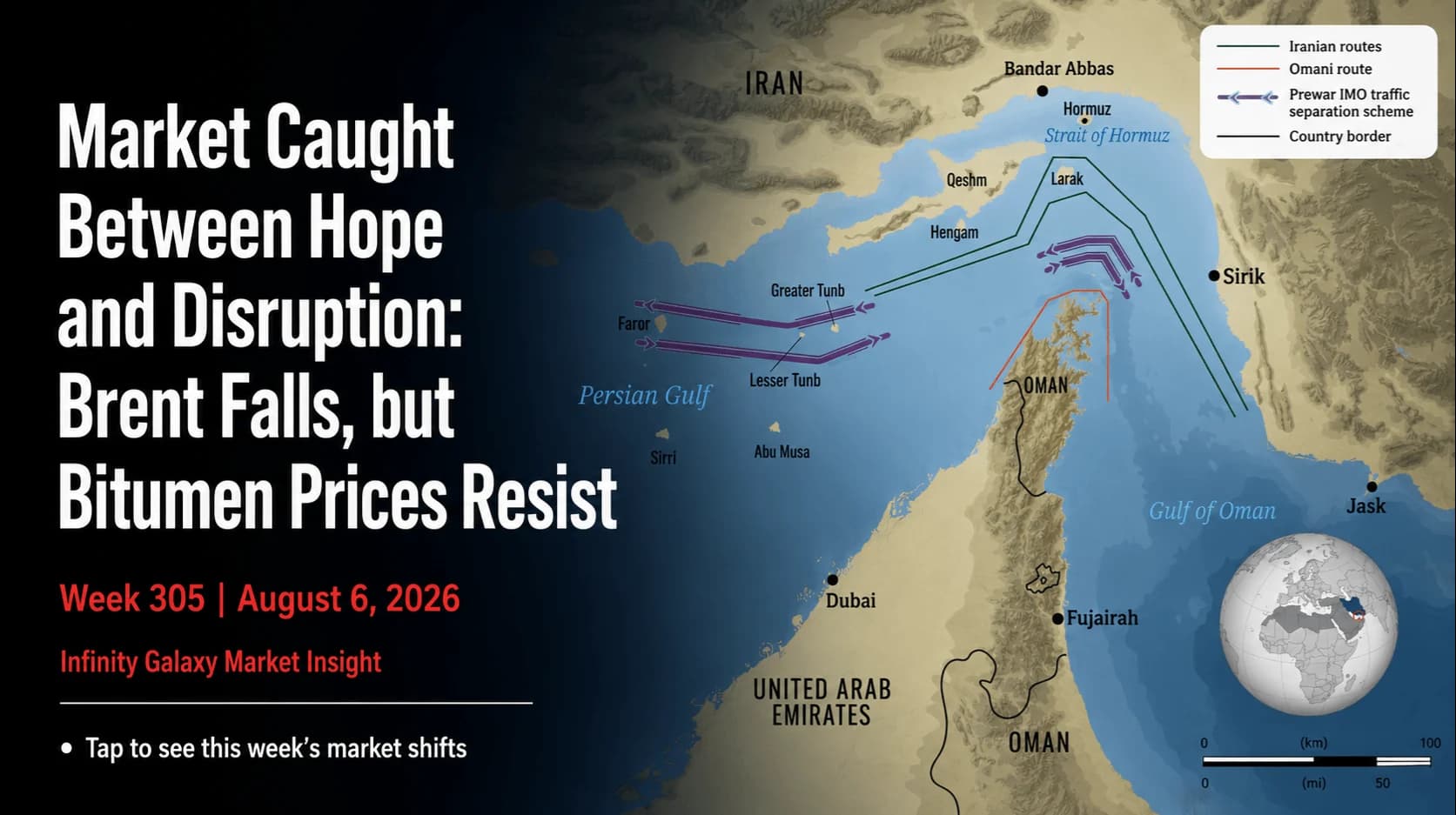
A week that began with unchanged US interest rates, renewed inflation concerns, and continued Russian pressure on Ukraine quickly returned to the shadow of the Middle East. Russia’s missile attacks and Ukraine’s shortage of air-defense systems showed that geopolitical risk remains widespread. For the global energy market, however, the decisive issue was not the Ukrainian front, but the possibility of renewed US-Iran conflict and the future of vessel traffic through Hormuz Strait. Washington’s decision to postpone military action temporarily shifted market sentiment away from immediate escalation and towards the possibility of an agreement.
Diplomacy Moves Forward, but Hormuz Strait Has Not Fully Reopened
By 6 August, Iran and Oman had reached a preliminary understanding over the coordinates of a shipping corridor through Hormuz Strait. However, this progress does not yet represent a final agreement or the full and secure reopening of the strait. Key issues remain unresolved, including Iran’s level of control over incoming vessels, inspection procedures for outbound traffic, and possible transit charges. The United States is reportedly seeking a zero-fee arrangement, while Iran and Oman are discussing charges equal to approximately 3%–7% of cargo value.
Meanwhile, oil exports from Persian Gulf countries remain around 40% below pre-war levels. Tehran has also warned that any new US attack could expose regional energy infrastructure to retaliatory action. The probability of an agreement has increased, but normal shipping operations have not yet resumed.
Brent Oil Price Returns to the $79 Range
The change in market expectations pushed the Brent Oil Price sharply lower. Brent, which traded above $80 and at times close to $90 at the end of July, fell by around 7% after the US suspended its planned attack on 3 August and declined by more than 5% the following day. By Thursday morning, 6 August, Brent crude had returned to approximately $79 per barrel.
Singapore Bitumen Remains Expensive, South Korea Is Stable, and China Becomes a Limited Alternative
In East Asia, international market reports assessed Singapore Bitumen at around $620 per metric ton, while South Korea Bitumen traded close to $530. Current supply conditions have also encouraged China to increase bitumen exports while continuing to import cargoes at the same time.
Some international assessments placed export cargoes from southern China at around $615–$625 per metric ton.
India Bitumen: Refinery Prices Fall, but Imports Remain Expensive
Monsoon pressure and weak demand forced Indian refiners to reduce Bitumen Prices by around $22 per metric ton from 1 August. However, the reduction has not yet transferred to the imported market.
Restrictions on loading from Iran and continued uncertainty over Hormuz Strait have kept import costs high. India Bitumen buyers are therefore comparing lower domestic refinery prices with the higher commercial and logistical risks associated with foreign supply.
European Bitumen Moves Lower, Bahrain Remains Stable
In Europe, declining HSFO prices, increased Spanish supply, and weaker project activity during the summer holiday period pushed Bitumen Prices lower. The overall European export market was assessed at approximately $505-$535 per metric ton.
Bahrain Bitumen remained unchanged and has held broadly stable for more than six consecutive months.
Iran Bitumen: Hormuz Strait Remains the Main Barrier
In Iran, high shipping risk, elevated port costs, and uncertainty over loading schedules have kept exports near their lowest levels of recent months. Alternative export routes do not have sufficient capacity to replace Bandar Abbas, leaving the Iran Bitumen Market highly dependent on the reopening of Hormuz Strait.
Until regular maritime traffic resumes, Iran’s export recovery will remain limited regardless of the prices announced by suppliers.
Insight from Razieh Gilani: Trust Is Part of the Real Price
The final market picture remains divided. Lower Brent prices and the growing possibility of an agreement support a reduction in underlying oil costs. However, until regular vessel traffic and reliable loading schedules are restored, the Persian Gulf and Asian Bitumen Markets will continue to face real supply constraints.
Under these conditions, the cheapest offer is not necessarily the best price. A price becomes meaningful only when the seller can control product availability, vessel access, loading time, and delivery conditions at the same time.
For current bitumen prices, cargo availability, and reliable shipping guidance, Contact Us.
Comments
Share your thoughts...
More Reports
Curious to see more, discover more articles, and stay up-to-date?