Bitumen
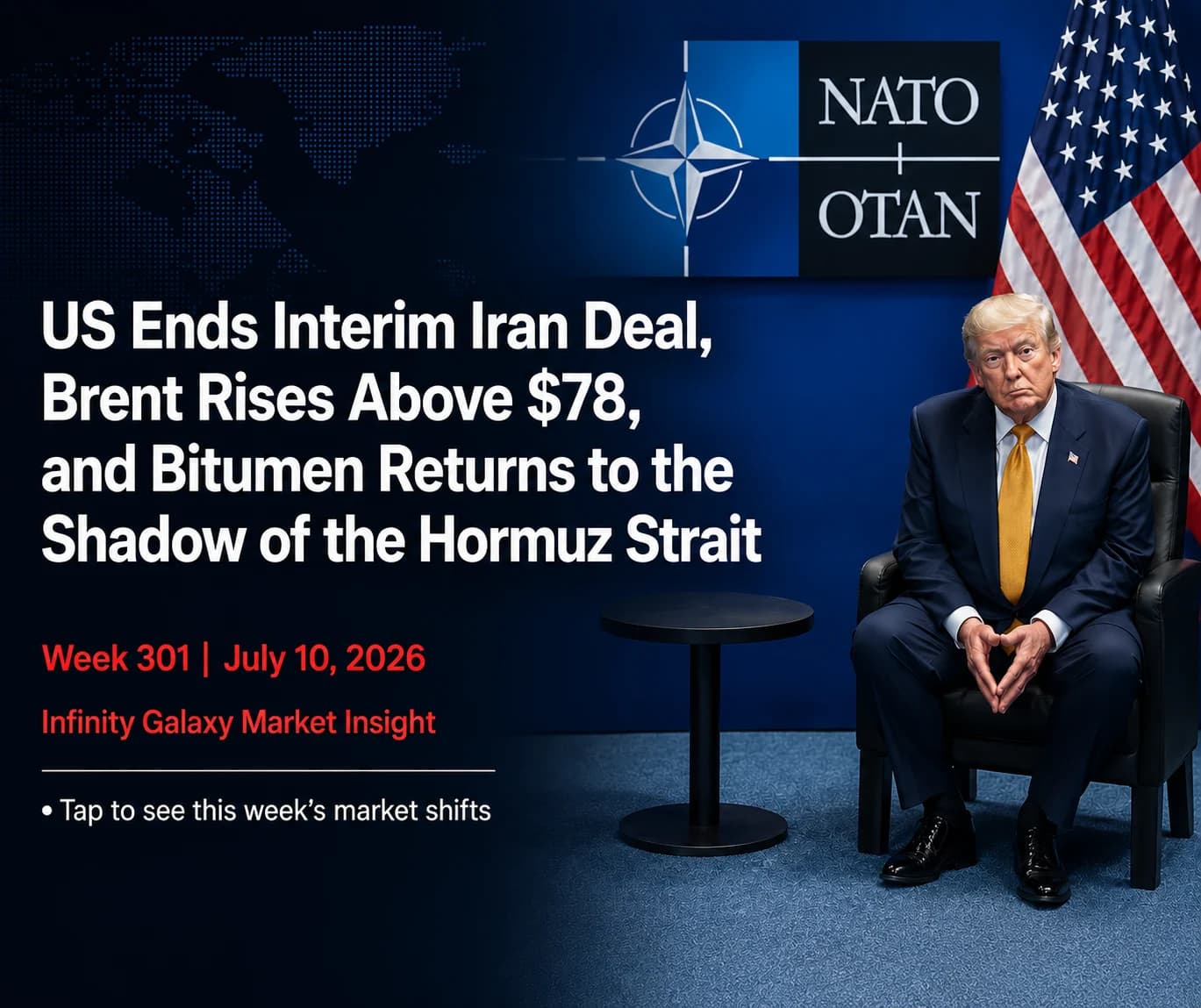
Weekly Bitumen Report: US Ends Interim Iran Deal, Brent Rises Above $78, and Bitumen Returns to the Shadow of the Hormuz Strait
Global energy markets shifted again as the US ended the interim Iran deal, renewed sanctions risk, and rising tensions around the Hormuz Strait pushed Brent above $78. This week’s Bitumen Report explores how shipping risks, freight costs, and geopolitical uncertainty may reshape bitumen prices and supply conditions.

Tensions Return and the Energy Market Changes Direction Again
The global energy market changed direction within only a few days. On July 8, Donald Trump announced that the 60-day interim arrangement with Iran was effectively over, although a return to negotiations has not been completely ruled out.
At the same time, the United States revoked the temporary license that had allowed limited sales of Iranian crude oil, petroleum products, and petrochemicals until August 21. As a result, a market that had recently begun pricing in a gradual return to stability is once again facing sanctions risk, military escalation, and uncertainty over Iranian oil exports.
Vessel Attacks and Military Escalation Reopen the Shipping Risk
The policy shift followed attacks on three commercial vessels near the Hormuz Strait and the Gulf of Oman, including a Qatari LNG carrier. Washington and Doha blamed Iran, while Tehran denied direct responsibility.
The United States then carried out two consecutive waves of strikes against more than 80 and later around 90 military and maritime targets in southern Iran. Iran responded with missile and drone attacks against US-linked military facilities in Bahrain and Kuwait.
Energy risk also remained elevated outside the Middle East. The Israel-Lebanon peace framework is still in place, but implementation remains uncertain. At the same time, Ukraine launched a major wave of drone attacks against Russian refineries, pumping stations, and tankers, contributing to tighter domestic fuel supply and a temporary Russian diesel export ban. Russia also launched ballistic missile attacks against Ukraine. These developments do not directly set the bitumen price, but they continue to support global energy costs and supply risk for heavy petroleum products.
Brent Oil Price: The War Premium Returns
Brent crude was still trading in the low $70s at the beginning of the week, but by July 9 it had climbed to around $79 per barrel and briefly moved above $80, representing a weekly increase of nearly 9%.
The reasons were clear: the cancellation of the temporary Iran oil license, attacks on commercial vessels, renewed US military strikes, and lower confidence in the sustainable reopening of the Hormuz Strait. The latest reliable Brent oil price was around $78.90 per barrel.
The market is not yet pricing in a full-scale war as its base scenario, but it is once again paying a risk premium for possible supply disruption, vessel delays, and reduced oil flows from the Middle East.
From Oil to Bitumen: Shipping Becomes the First Variable Again
For the bitumen market, the first impact of the renewed tension is not coming from production costs. It is coming from the ability to execute shipments.
As threats against commercial vessels increase, some tankers have turned away from the Hormuz Strait, while shipowners are again reviewing war-risk insurance, waiting times, loading schedules, and route exposure.
This means that even if the FOB bitumen price has not yet moved significantly, delivered prices can rise quickly through higher freight, war-risk premiums, demurrage, and limited vessel availability. The gap between a quoted price and an executable price is widening again.
East Asia Bitumen Market: Prices Fell Before the Latest Escalation
In Singapore, Platts assessed HSFO 180 CST at around $451 per metric ton and HSFO 380 CST at approximately $445 per metric ton on July 8. Singapore bitumen 60/70 was assessed at around $573 per metric ton, while South Korea bitumen stood near $489.
These levels showed that the Singapore bitumen and South Korea bitumen markets had corrected before the latest escalation. In China, rainfall, limited project funding, and cautious buying continued to weaken demand. However, lower domestic refinery output and limited regional supply prevented a sharper decline in China bitumen prices.
India Bitumen Market: Monsoon Slows Demand, but Supply Remains Tight
In India, demand remained relatively strong in northern and parts of central India, while the monsoon season limited road construction activity in other regions.
Before the latest escalation, improving conditions in the Persian Gulf had created expectations that India bitumen prices could gradually move lower. However, renewed shipping risk and higher Middle East freight costs may reverse that trend.
The next direction of the India bitumen market will depend less on headline crude prices and more on whether Gulf cargoes can move consistently and at workable freight levels.
Europe Lower, Bahrain Stable, and Iran Bitumen Caught Between Price and Execution
In Europe, the market remained under downward pressure until July 3, with export bitumen prices from the Mediterranean, Baltic, and Rotterdam assessed at approximately $415 to $445 per metric ton.
Bahrain bitumen remained unchanged at around $550 per metric ton.
In Iran, drummed bitumen was trading above $400 FOB Bandar Abbas before the interim arrangement was cancelled. The impact of the latest strikes, renewed sanctions pressure, and higher shipping risk on Iran bitumen prices, vessel availability, loading schedules, and freight costs now needs to be reassessed. The market has not yet fully priced in the new level of risk.
Conclusion: Brent Moved First, while Bitumen Waits for the Real Shipping Cost
The market picture on July 9 is clear: Brent reacted immediately, but the bitumen market is still waiting for shipowners, insurers, and shipping lines to determine the next direction.
If military attacks stop and negotiations remain open, part of the Brent oil price increase may be corrected, while Asian bitumen could again come under pressure from weak demand.
However, if traffic through the Hormuz Strait becomes more restricted, lower supply from Iran and the Persian Gulf, higher freight rates, and delayed cargoes could push delivered bitumen prices higher even without a major increase in FOB prices.
At this stage, political news only matters when it becomes a vessel, a loading schedule, and a deliverable cargo.
Insight from Razieh Gilani at Infinity Galaxy
In a market that can move from negotiation to military escalation within hours, a delayed response is itself a commercial risk.
A reliable supplier is not simply the one offering an attractive price. The seller must remain available, review the offer when conditions change, and clearly explain what can still be executed.
In this environment, trust is not built through promises. It is built through fast communication, realistic pricing, and predictable delivery.
Contact Us
Need the latest market insight or a reliable bitumen quotation? Contact us for current availability, pricing, and shipment support from Infinity Galaxy.
Comments
Share your thoughts...
More Reports
Curious to see more, discover more articles, and stay up-to-date?