Caustic Soda
Caustic Soda or Sodium Hydroxide: What It Is, Formula and Other Names
Last updated: October 2026 | Caustic soda is another name for sodium hydroxide (NaOH), a strong white alkali. Learn its formula, other names, forms, main uses and key safety rules in this simple guide.

- What is Caustic Soda or Sodium Hydroxide?
- Caustic Soda Formula and Chemical Identity
- What Does Caustic Soda Look Like?
- What are the Other Names of Caustic Soda?
- Caustic Soda Types and Grades
- How Caustic Soda is made?
- Caustic Soda Properties
- Caustic Soda Applications
- Caustic Soda Tests
- Caustic Soda Storage and Handling
- Buying Caustic Soda in Bulk
- Caustic Soda FAQ
Caustic soda is the common name of sodium hydroxide. It is one chemical with the formula NaOH, so the two names mean exactly the same thing.
It is strong, white alkali (base) that dissolves easily in water and releases heat while dissolution. Factories use it to make paper, soap, aluminium and fabric. It also cleans drains and treats water.
It is also dangerous. Caustic soda burns skin and eyes within seconds. This guide explains what it is, how to write its formula, what other names it has, which forms you can buy, and the safety rules you need to know.
What is Caustic Soda or Sodium Hydroxide?
Caustic soda is a strong base, also called an alkali. Chemists call it sodium hydroxide. It is made of sodium ions (Na⁺) and hydroxide ions (OH⁻), and these ions separate when it dissolves in water. This is why it reacts so strongly with acids, fats and many other materials.
The word "caustic" means "able to burn". Caustic soda earns this name because it destroys skin, wool, paper and other organic matter on contact. A solution of it also feels slippery and soapy, because it starts to turn the oils in your skin into soap. Never touch it to test this.
Most caustic soda is made by passing electricity through salt water. This process gives caustic soda, chlorine and hydrogen together, and it makes about 1.1 tonnes of caustic soda for every tonne of chlorine. For this reason, the caustic soda market follows the chlorine market. One market estimate puts world volume at about 84 million tonnes in 2025, although reports give different totals.
Caustic Soda Formula and Chemical Identity
The formula of caustic soda is NaOH. It has one sodium atom (Na), one oxygen atom (O) and one hydrogen atom (H). In water it splits like this: NaOH → Na⁺ + OH⁻. Because it splits almost completely, chemists call it a strong base.
The table below shows the basic identity of caustic soda. You will often find these numbers on a product label or safety data sheet.
| Item | Value |
|---|---|
| Chemical name | Sodium hydroxide |
| Common names | Caustic soda, lye |
| Formula | NaOH |
| Molar mass | About 40 g/mol |
| CAS number | 1310-73-2 |
| EC number | 215-185-5 |
| UN number | 1823 (solid), 1824 (solution) |
| Transport hazard class | 8 (corrosive) |
| Appearance | White solid or clear, colourless liquid |
| Smell | None |
| Type | Strong base (alkali) |
For more details on Sodium hydroxide properties like melting point, density and solubility, see the Caustic Soda Properties.
What Does Caustic Soda Look Like?
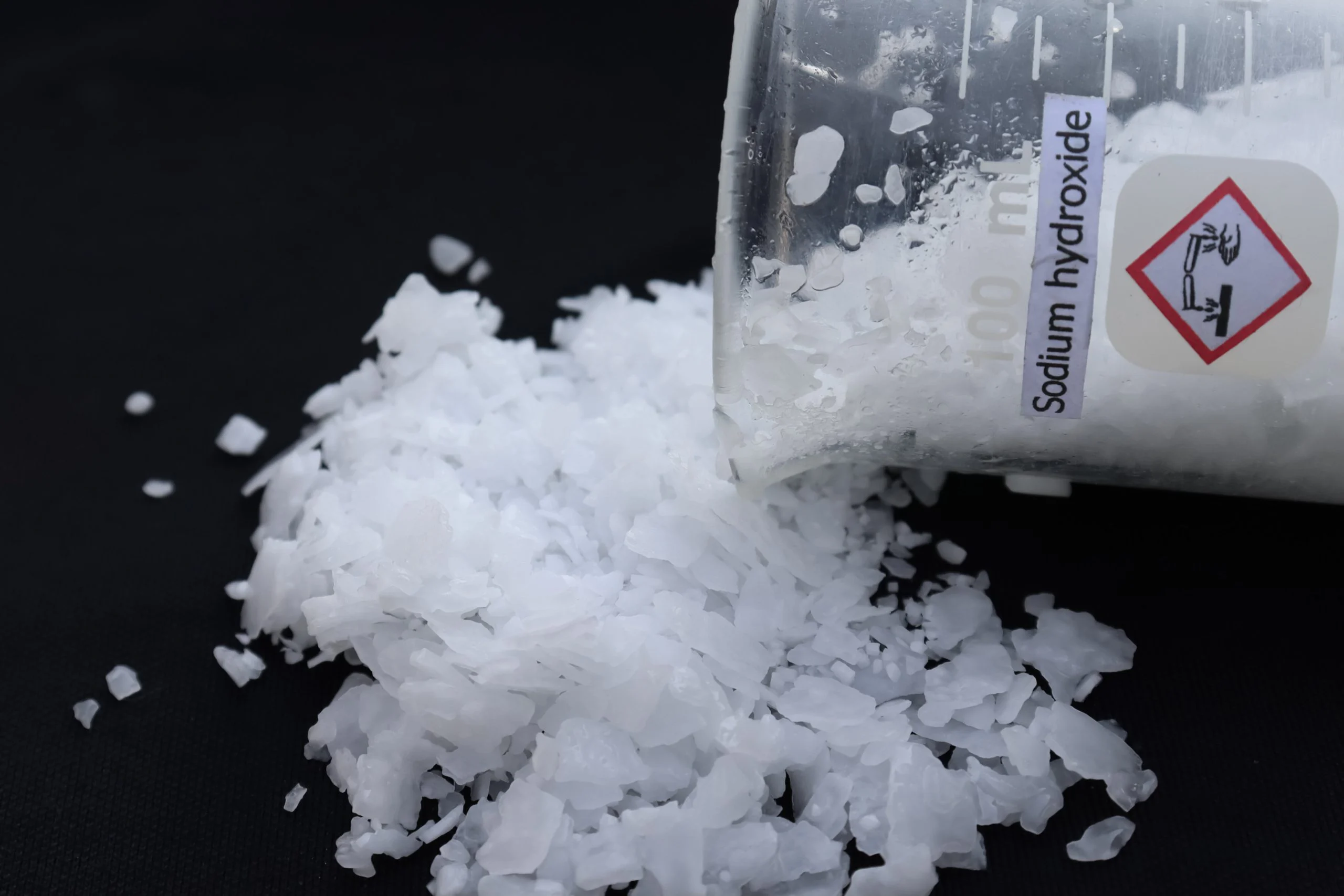
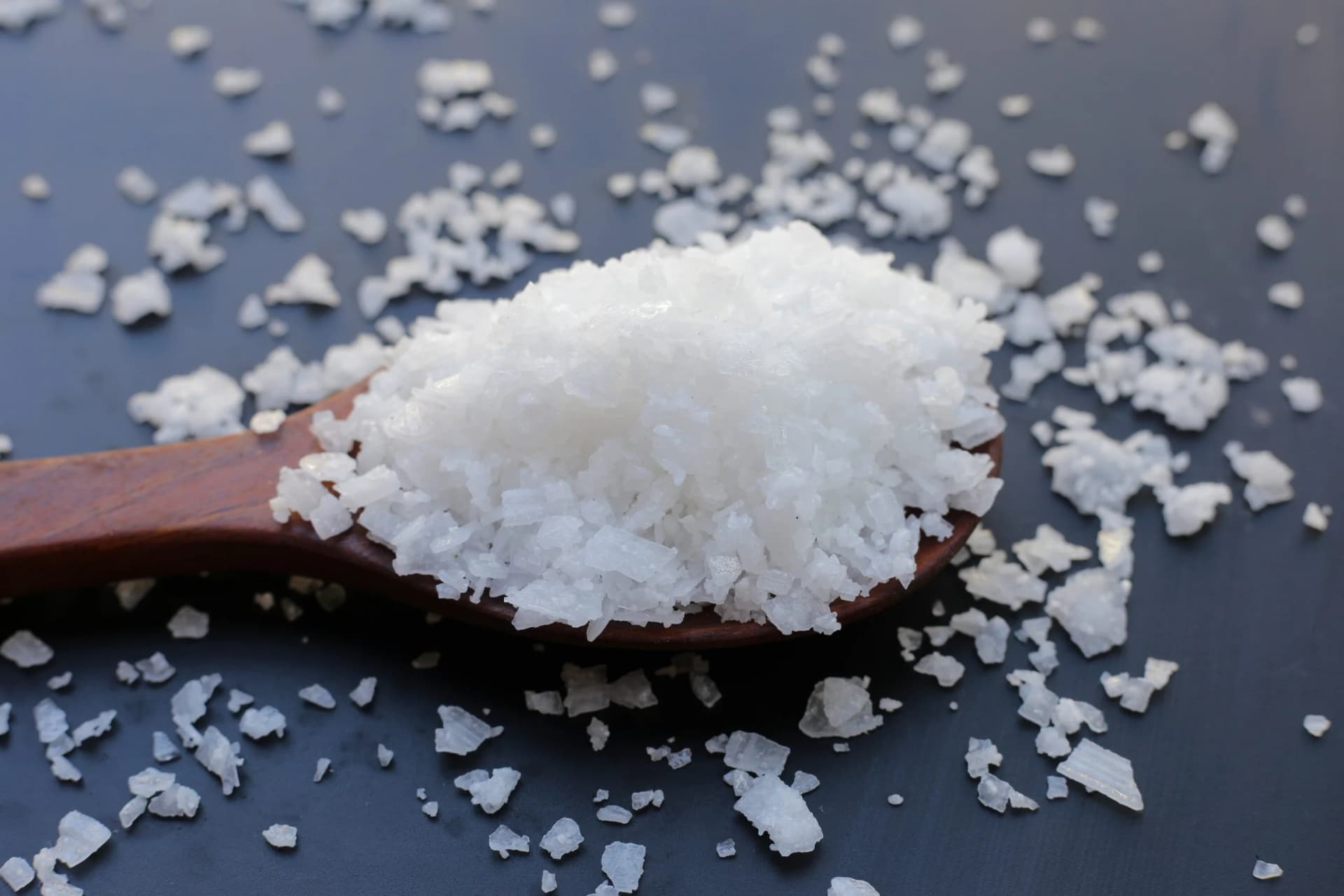
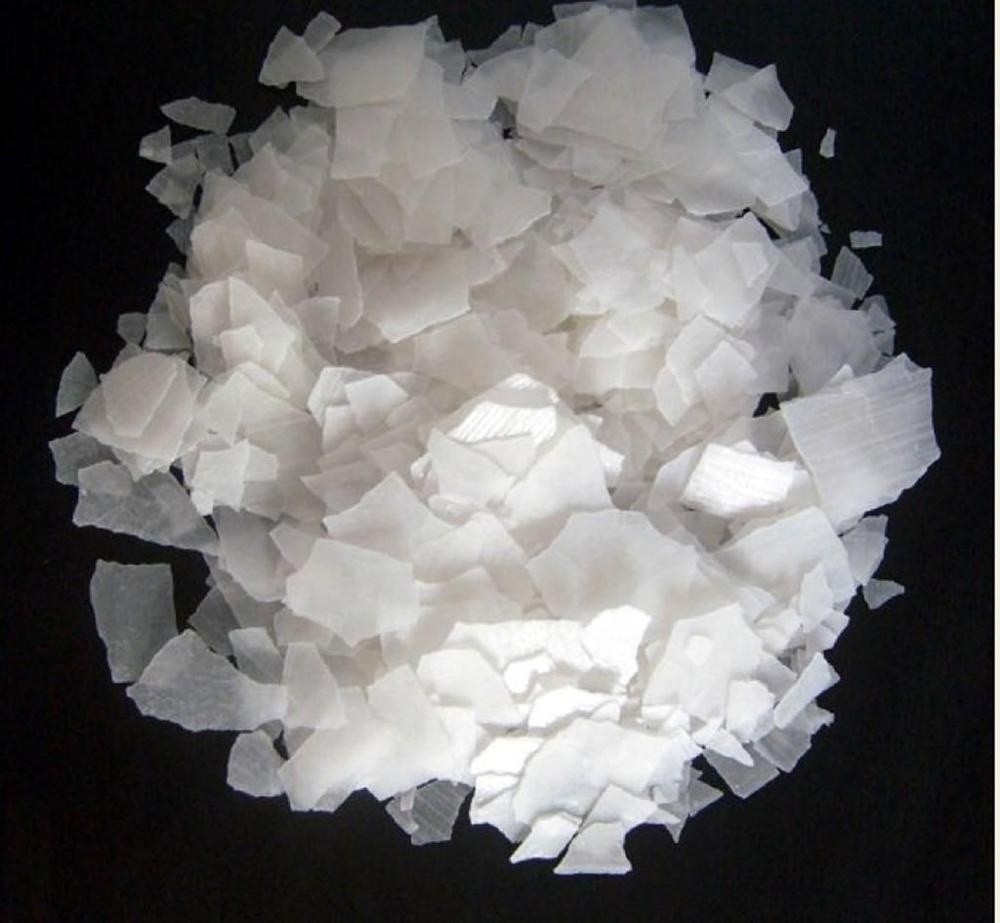
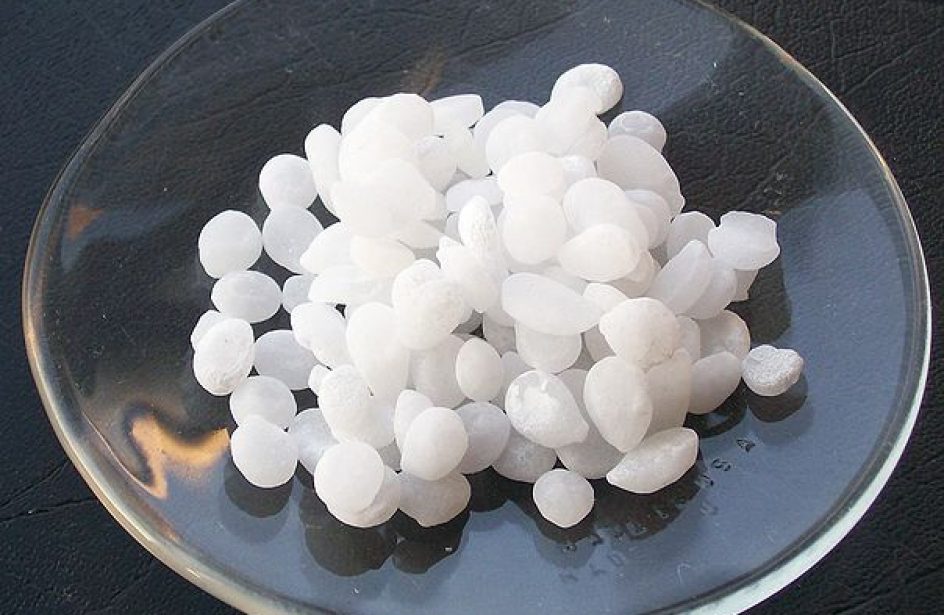
Solid caustic soda is white and has no smell. It comes as thin flakes, small round pearls or hard pellets. The liquid form is clear and a little thicker than water.
Caustic soda pulls water vapour from the air. Open flakes turn sticky and then form hard lumps. They also absorb carbon dioxide from the air, and a layer of sodium carbonate slowly forms on the surface. This is why every container must stay tightly closed.
What are the Other Names of Caustic Soda?
People use different names for caustic soda, depending on where they work. Traders and factory staff say "caustic soda". Chemists, teachers and safety sheets say "sodium hydroxide". Soap makers say "lye". All of them mean the same chemical.
In trade, "lye" usually means the liquid form. This is why many suppliers sell "caustic soda lye" as a 50% solution.
| Name | Where you see it | Note |
|---|---|---|
| Sodium hydroxide | Labs, schools, safety data sheets, labels | The official chemical name |
| Caustic soda | Trade, factories, price lists | The most common name in industry |
| Lye, soda lye | Soap making, drain cleaners | In old books, "lye" can also mean potassium hydroxide |
| Sodium hydrate | Old chemistry books | An older name for NaOH |
| NaOH | Formulas and equations | The chemical symbol |
| Liquid caustic, caustic soda lye | Trade | The water solution, usually 50% |
Is Caustic Soda the Same as Sodium Hydroxide?
Yes. Caustic soda and sodium hydroxide are the same compound, NaOH. They share one CAS number, 1310-73-2, so a supplier may use either name for the same product.
The difference is only a habit of language. "Sodium hydroxide" is the scientific name, and "caustic soda" is the trade name. The forms and purity you buy may differ, for example lab pellets compared with industrial flakes, but the chemical itself does not.
Caustic Soda vs Lye, Soda Ash and Baking Soda
Several white powders have "soda" in their name, and people often mix them up. Only the first two rows below are caustic soda. The pH values are for 0.1 M solutions and are approximate.
| Name | Formula | Strength | Typical use | Same as caustic soda? |
|---|---|---|---|---|
| Caustic soda (sodium hydroxide) | NaOH | Strong base (pH about 13) | Paper, soap, alumina, drain cleaner | — |
| Lye | NaOH or KOH | Strong base | Soap making, cleaners | Usually yes, check the label |
| Caustic potash (potassium hydroxide) | KOH | Strong base | Liquid soap, alkaline batteries | No, a different chemical |
| Soda ash, washing soda | Na₂CO₃ | Medium base (pH about 11.6) | Glass, detergent, laundry | No |
| Baking soda | NaHCO₃ | Weak base (pH about 8.3) | Cooking, antacid | No |
Names like "soda salt" or "caustic salt" are not standard. People usually mean caustic soda (NaOH) or soda ash (Na₂CO₃). The formula on the label tells you which one you have.
Caustic Soda in Other Languages
Many readers search for the name in their own language. In most of them, the name is simply the English term written in local letters.
All these names point to the same chemical, NaOH.
| Language | Name |
|---|---|
| Hindi | कास्टिक सोडा |
| Bengali | কস্টিক সোডা |
| Gujarati | કોસ્ટિક સોડા |
| Tamil | காஸ்டிக் சோடா |
| Telugu | కాస్టిక్ సోడా |
| Malayalam | കാസ്റ്റിക് സോഡ |
| Tagalog | Caustic soda ("Lye" is lihiya) |
Caustic Soda Types and Grades
Caustic soda has three main shapes: pearls, flakes and liquid. All three are NaOH, but the shape changes how you measure, store and ship it. The table gives a quick comparison.
| Form | What it looks like | Concentration or size | Common use |
|---|---|---|---|
| Caustic soda pearls (granulated caustic soda) | Small white balls | Under 1 mm | Easy-to-pour solid, less dust than flakes |
| Caustic soda flakes | Thin, flat white pieces | About 0.8–1.2 mm, usually 98–99% NaOH | Textiles, soap, paper, alumina |
| Caustic soda liquid (lye) | Clear, colourless liquid | Usually 50% NaOH | Water treatment, large plants with tanks |
Solid types are easier to measure, move and store, so smaller buyers usually choose flakes or pearls. Liquid is cheaper to make, but it is heavy to ship because half of it is water. One market report estimates that liquid made up about two thirds of caustic soda demand in 2025. Plants that sit near a chlor-alkali factory can receive it through pipes.
A 50% solution starts to crystallise at about 12 °C. In cold places, the tanks and pipes need heating or insulation.
For more detail on every form, read the caustic soda types and grades article. If you want current prices for flakes, see caustic soda flakes 98%
How Caustic Soda is made?
Almost all caustic soda comes from electrolysis of brine, which is salt dissolved in water. An electric current splits the brine. Chlorine forms at one electrode, and hydrogen and hydroxide ions form at the other. The sodium ions join the hydroxide ions, and this gives sodium hydroxide solution.
Plants use three types of cells for this job:
- Mercury cell process
- Diaphragm cell process
- Membrane cell process
The membrane cell uses the least energy and gives the purest product, so most new plants use it. Mercury cells are being phased out because of mercury pollution.
The liquid that leaves a membrane cell is about one third caustic soda. Plants then evaporate water to reach 50%, and further drying gives flakes and pearls.
Want every step in detail? Read the caustic soda production process article.
Caustic Soda Properties
Caustic soda properties fall into two groups: physical and chemical.
Physical properties. Sodium hydroxide is a white solid at room temperature. It dissolves very well in water, and the water heats up a lot while it dissolves. Different sources give slightly different melting points, so the table shows a range.
| Property | Value |
|---|---|
| Melting point | About 318–323 °C |
| Boiling point | About 1,388 °C |
| Density (solid) | 2.13 g/cm³ |
| Solubility in water | About 1,000 g/L at 25 °C (418 g/L at 0 °C, 3,370 g/L at 100 °C) |
| pH | About 13 (0.1 M solution) and about 14 (strong solutions) |
| Flammable? | No |
Chemical properties. Caustic soda reacts with many things, and each reaction explains one of its jobs:
- Acids: it neutralises them and forms water and a salt. With hydrochloric acid it makes table salt.
- Acidic gases: it absorbs carbon dioxide and sulfur dioxide.
- Metals: it attacks aluminium and zinc and releases hydrogen gas. Never store it in aluminium containers.
- Fats and oils: it turns them into soap.
- Glass: it slowly attacks glass at room temperature.
Always add caustic soda to water slowly. Never add water to caustic soda. The heat can make the liquid boil and splash.
Read more in the caustic soda physical and chemical properties article.
Caustic Soda Applications
Alumina production, pulp and paper, and chemical manufacturing are the main users of caustic soda. The table below shows what it does in each industry.
| Industry | What caustic soda does |
|---|---|
| Alumina production | Dissolves alumina out of bauxite ore (the Bayer process) |
| Pulp and paper | Separates cellulose fibres from wood and bleaches the pulp |
| Chemical manufacturing | Works as a raw material and controls pH in making detergents, dyes and drugs |
| Soap and detergent | Turns fats and oils into soap |
| Textiles | Makes cotton stronger, shinier and better at taking dye |
| Water treatment | Raises pH, neutralises acid and helps remove heavy metals |
| Petroleum | Used in refining, drilling fluids and petrochemicals |
| Cleaning | Dissolves grease and opens blocked drains |
| Agriculture | Controls pH, cleans equipment, helps make pesticides and animal feed |
| Food | Used in small amounts to peel fruit and vegetables, cure olives and make pretzels |
Food factories rinse away or neutralise the caustic soda, so the finished food has none left. Read more in caustic soda in the food industry, caustic soda in agriculture and caustic soda in pulp and paper.
For the full list, read the caustic soda applications article.
Caustic Soda Tests
Caustic soda is never 100% pure. Small amounts of other compounds stay in it, so buyers check quality with caustic soda tests. The NaOH content is usually measured by titration with a standard acid.
| Test | What it tells you | Example limit (solid grade, one supplier's data sheet) |
|---|---|---|
| Sodium hydroxide content | Main purity | 99.0–99.7% |
| Carbonate (Na₂CO₃) | Contact with air | Below 0.4% |
| Salt (NaCl) | Left over from the brine | Below 0.04% |
| Sulfate (Na₂SO₄) | Impurity from the brine | Below 0.02% |
| Iron (Fe) | Colour and corrosion risk | Below 10 mg/kg |
These limits are only an example. Always check the specification your supplier promises on the certificate of analysis.
Caustic Soda Storage and Handling
Caustic soda is a hazardous material. Store it in tightly closed containers, in a cool, dry place with good ventilation. Keep it away from sunlight, moisture, acids, and metals such as aluminium and zinc.
| Do | Don't |
|---|---|
| Wear splash goggles, chemical-resistant gloves, apron and boots | Touch it with bare hands |
| Add caustic soda to water slowly | Pour water onto solid caustic soda |
| Keep containers closed and labelled | Store it in aluminium or zinc containers |
| Keep an eyewash station and plenty of clean water nearby | Mix it with acids |
If it touches your skin: remove wet clothing and rinse with plenty of running water for at least 15 minutes, then get medical help. If it gets in your eyes: rinse with clean water for at least 15 minutes, hold the eyelids open, and call a doctor straight away. If swallowed: rinse the mouth, do not make the person vomit, and get emergency help immediately.
This is general information. Always follow the safety data sheet (SDS) from your supplier. For tank materials, container types and full safety rules, read caustic soda storage tank, handling, container and safety.
Buying Caustic Soda in Bulk
If you need caustic soda for a plant or a business, you usually buy it by the tonne, not by the kilo. Before you order, check the form (flakes, pearls or 50% liquid), the NaOH purity, the packing type and the certificate of analysis.
You can see today's caustic soda price, the caustic soda flakes 98% product page.
We would be glad to hear your thoughts! Feel free to share your comments or reach out to us on WhatsApp for any further questions or inquiries about caustic soda.
Caustic Soda FAQ
What is caustic soda?
Caustic soda is the common name of sodium hydroxide (NaOH). It is a strong white alkali used to make paper, soap, aluminium and textiles, and to treat water. It is corrosive and burns skin and eyes.
Is caustic soda the same as sodium hydroxide?
Yes. Both names mean the same chemical, NaOH, with CAS number 1310-73-2. "Sodium hydroxide" is the scientific name and "caustic soda" is the trade name.
What is the chemical formula of caustic soda?
The formula is NaOH. It has one sodium atom, one oxygen atom and one hydrogen atom. In water it splits into Na⁺ and OH⁻ ions.
What is NaOH?
NaOH is the chemical symbol of sodium hydroxide, which is caustic soda. It is a strong base that reacts quickly with acids, fats and some metals.
What is the difference between caustic soda and lye?
In most cases there is no difference, because lye usually means sodium hydroxide. In old books, however, lye can also mean potassium hydroxide (KOH), so check the formula on the label.
Is caustic soda the same as baking soda?
No. Baking soda is sodium bicarbonate (NaHCO₃), a weak base you can eat in cooking. Caustic soda is NaOH, a strong base that burns skin.
What is caustic soda used for?
The biggest users are alumina production, pulp and paper, and chemical factories. It is also used in soap, textiles, water treatment and drain cleaners. See the caustic soda applications article for details.
Is caustic soda dangerous?
Yes. It causes severe burns on skin and eyes, and dust or mist can hurt your nose and throat. Wear goggles, gloves and protective clothing, and rinse with water for at least 15 minutes after any contact.
What is the difference between caustic soda flakes and pearls?
Both are solid NaOH. Flakes are thin, flat pieces, while pearls are small round balls. Read the caustic soda types and grades article to compare them.
Comments
Share your thoughts...
Latest
From the blog
Curious to see more, discover more articles, and stay up-to-date?