Africa’s Bitumen Market Shows Mixed Trends: Cheaper in the West, Tighter in the East
The deadlock between Iran and the United States over the Strait of Hormuz continues to keep direct sourcing from the Persian Gulf under pressure, with shipping, payment and scheduling constraints still affecting trade. At the same time, a significant decline in crude and Mediterranean HSFO over the past week has lowered replacement costs in West...

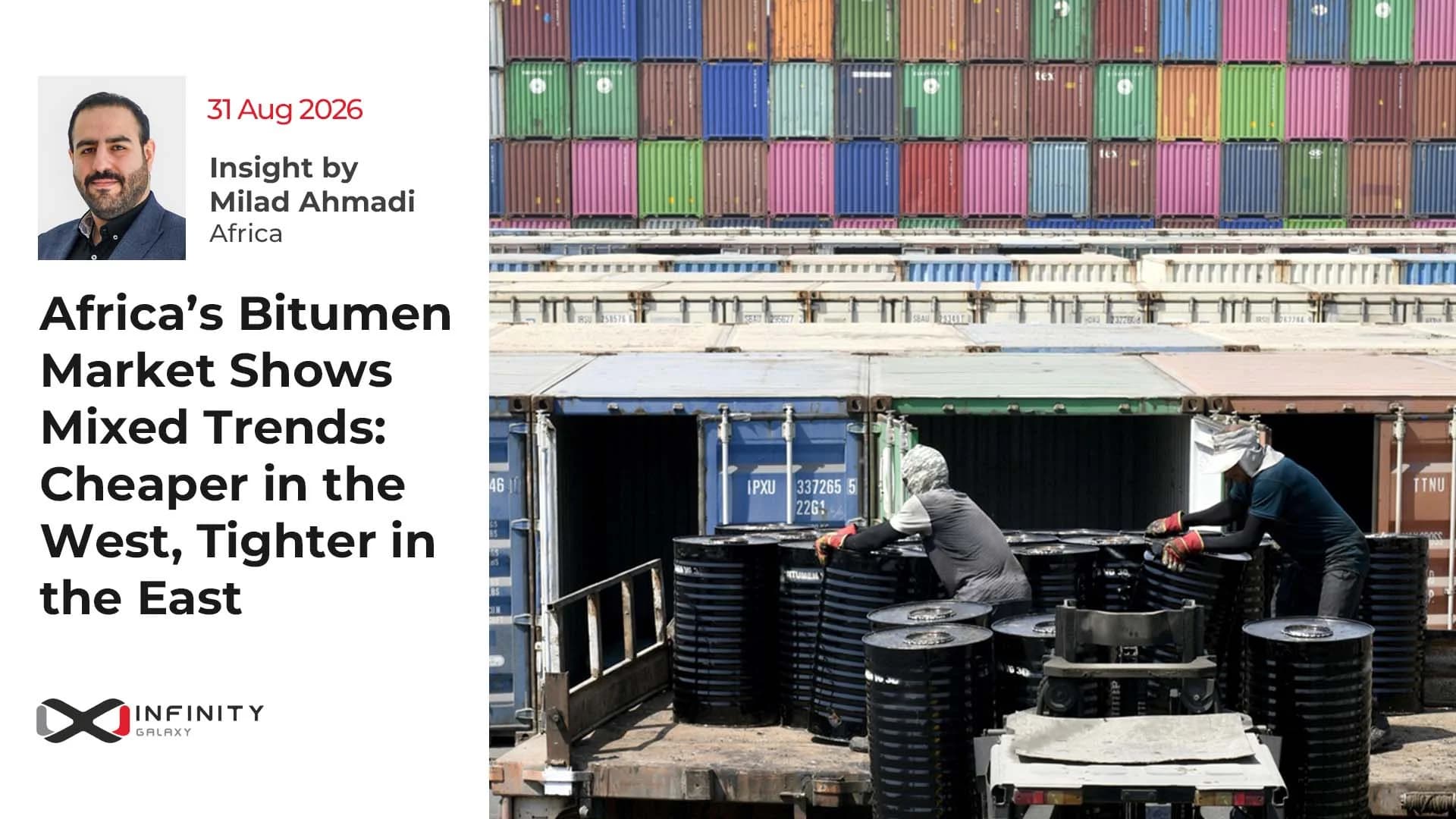
The deadlock between Iran and the United States over the Strait of Hormuz continues to keep direct sourcing from the Persian Gulf under pressure, with shipping, payment and scheduling constraints still affecting trade.
At the same time, a significant decline in crude and Mediterranean HSFO over the past week has lowered replacement costs in West Africa.
East Africa, however, is facing a different picture. Availability has improved, but Iranian origin prices and the cost of some alternative routes have moved higher again.
The result is a market that is no longer moving in one direction.
Nigeria: Lower CFR, But Buyers Are Still Not in a Hurry
Recent market discussions indicate that CFR Lagos has declined by around USD 38/MT compared with the previous week, with the market currently assessed at approximately USD 696–706/MT.
The decline has been driven mainly by corrections in crude, HSFO and cargo premiums rather than a significant increase in supply or demand.
Rainfall continues to limit consumption, while some cargoes are also being redirected toward other West African destinations due to weaker market conditions in Nigeria.
Market View:
For Nigerian buyers, the negotiating environment has improved compared with last week. However, a competitive offer should also come with a confirmed cargo, a clear loading window and a reliable ETA. A lower price alone is not sufficient reason to buy.
Ghana & Ivory Coast: Lower Prices, More Limited Availability from Abidjan
CFR levels in Ghana and FOB Abidjan have declined by approximately USD 35–40/MT this week.
However, market indications suggest that export availability from Abidjan has declined over the past several weeks, with fewer cargoes being loaded.
Market discussions are increasingly focused on production and feedstock limitations, although the exact cause has not yet been officially confirmed.
Therefore, the current lower price should not be confused with a genuine supply surplus.
Market View:
For Ghana and Ivory Coast, an important divergence has emerged: replacement costs have fallen, while local availability has weakened.
Buyers with a specific loading window should confirm actual availability before waiting for further price reductions.
Senegal, Guinea & Angola: Part-Cargo Remains a Practical Option
Cargo movements toward Dakar, Conakry and Luanda indicate that secondary West African markets continue to use part-cargo flows.
Part of this supply is coming from Mediterranean and Northern European origins.
This can provide additional options for buyers whose requirements are smaller than a full cargo, but available volume must be confirmed separately for each destination.
Market View:
Where volume and delivery windows are clearly defined, part-cargo can be a more practical option than waiting for a dedicated full cargo.
Kenya & Uganda: Supply Is Improving, But Sourcing Is Still Not Simple
The biggest change in East Africa this week has been the arrival of approximately 5,600 MT of Turkish cargo in Mombasa, significantly improving regional availability compared with previous weeks.
Demand in Kenya, Uganda and the DRC remains relatively active, while part of the Mombasa cargo is expected to serve inland markets.
However, suppliers that previously depended on Iran and the Persian Gulf are still looking for alternative origins. This means that supply has improved, but the market has not yet returned to normal.
Market View:
For Kenya and Uganda, buyers now have more options. However, they need to distinguish between cargo physically available in Mombasa and offers that are still dependent on shipping and payment arrangements.
Tanzania: CFR Moves Higher; Freight Remains Decisive
Unlike West Africa, CFR drums to Mombasa and Dar es Salaam have increased by approximately USD 8/MT this week.
Iranian origin prices have also moved slightly higher.
Market indications currently place bulk cargo from Bandar Abbas at approximately USD 304–318/MT FOB, while drummed cargo is assessed at around USD 390–410/MT FOB.
At the same time, freight from Bandar Abbas/Jebel Ali to Mombasa and Dar es Salaam remains around USD 255–270/MT.
More importantly, some alternative routes from Turkey have also become more expensive, with Mersin–Mombasa freight in some offers reaching approximately USD 400–420/MT.
Market View:
For Tanzania, comparing FOB prices alone is no longer sufficient.
Origin + freight + available sailing + payment route must be assessed together.
A lower FOB price may not necessarily result in a competitive CFR offer.
DRC & South Sudan | Demand Exists; The Route Determines the Decision
Regional demand across Kenya, Uganda, the DRC and South Sudan remains active, while improving supply in Mombasa could reduce part of the pressure seen over the past several weeks.
However, for inland markets, any delay in Mombasa or increase in trucking costs directly affects landed cost and delivery timing.
Market View:
For the DRC and South Sudan, the best offer is not necessarily the lowest-priced one.
Available stock, an executable inland route and delivery certainty remain more important than a few dollars of price difference.
South Africa: More Cargo, More Negotiating Power
Market activity remains relatively quiet ahead of the main paving season in September, while several cargoes from the Persian Gulf, Mediterranean and West Africa are either moving toward Durban or currently being discharged.
Additional cargo arrivals are expected from late August through the first half of September.
Under current conditions, supply is running ahead of demand.
Market View:
South Africa is currently not facing a supply shortage.
For buyers with genuine requirements, these conditions provide greater room to negotiate on CFR, ETA, discharge terms and prompt availability.
Africa Market Summary by Milad Ahmadi
Africa's bitumen market is showing three different pictures this week:
- West Africa: Cargo prices have declined significantly, but availability from some regional sources has become more limited.
- East Africa: Supply availability in Mombasa has improved, while origin costs and logistics remain high and unpredictable.
- Southern Africa: More cargo is entering the market while demand has not yet reached its seasonal peak.
Key Market Message
The market is no longer moving on price alone.
The real value of an offer today depends on four factors:
Available Cargo + Loading Window + Freight + Delivery Certainty
A lower FOB price does not automatically mean a better delivered deal, just as a higher cargo price does not necessarily indicate stronger demand.
The key is understanding what can actually be supplied, loaded and delivered within the buyer's required timeframe.
If you are active in any African market, send me your destination country, packaging requirement, approximate volume and preferred delivery timing.
I can take a closer look at the conditions on that specific route and assess which options are genuinely executable.
Comments
Share your thoughts...
More Reports
Curious to see more, discover more articles, and stay up-to-date?