Africa Bitumen Market
Africa Bitumen Market Update: After 60 Days, Supply Is Returning. Normality Isn’t
After 60 days, bitumen supply is returning to parts of Africa, but market conditions remain far from normal. Higher replacement costs, freight and execution risks continue to shape buying decisions, while West, East and Southern Africa move in different directions.

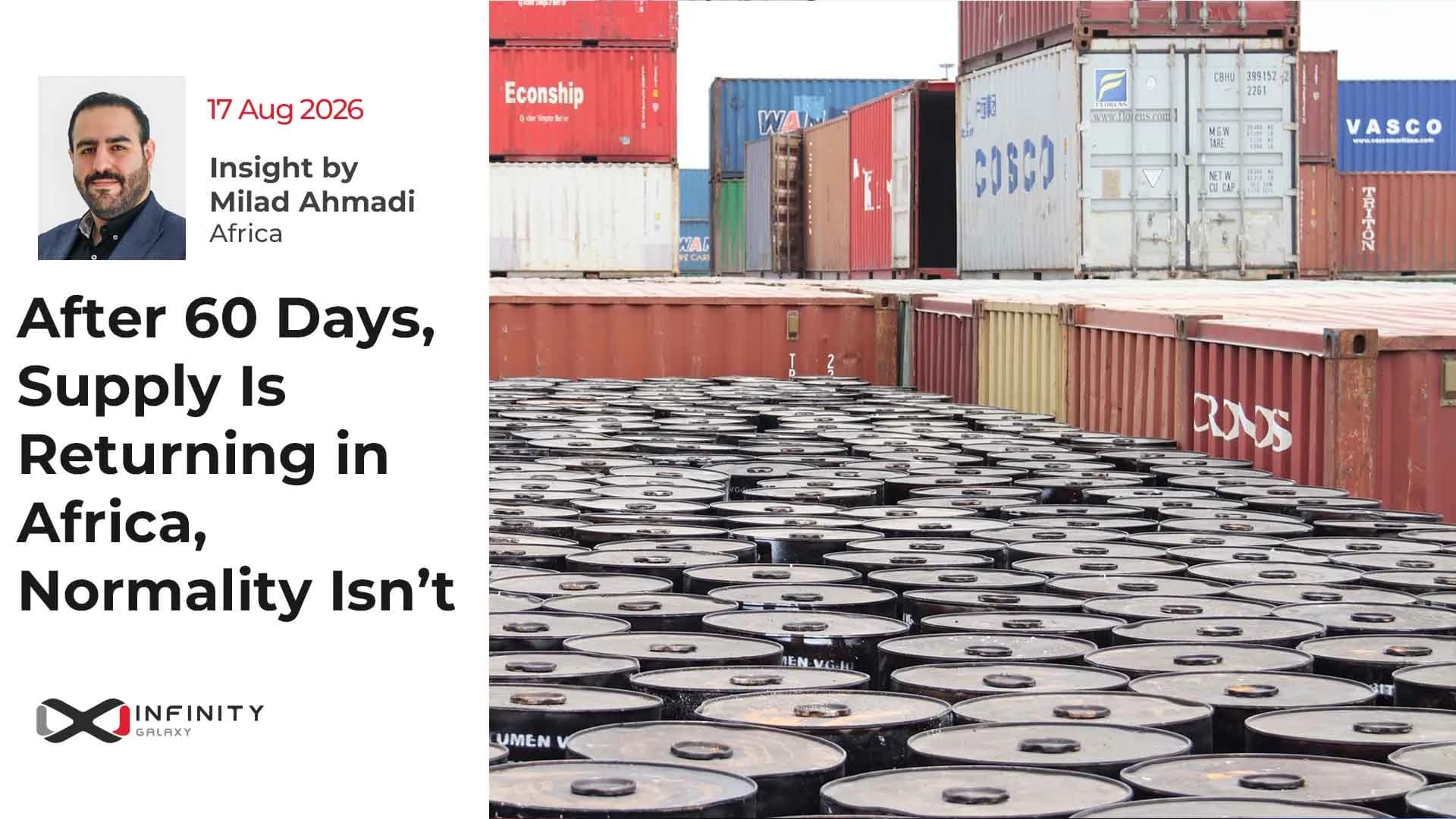
As the 60-day negotiation period between Iran and the United States approaches its end, there is still no clear sign of a return to normal transit and loading conditions through the Strait of Hormuz.
Across the market, shipping restrictions, insurance, payment limitations and the actual ability to load cargo from the Persian Gulf remain part of the buying decision. At the same time, renewed increases in crude oil and HSFO have pushed replacement costs higher in some African markets.
Nigeria | CFR Prices Recover, Demand Remains Cautious
Unlike last week, CFR Lagos offers have moved higher this week. Market indications suggest that this increase has been driven mainly by higher replacement costs, HSFO and crude oil rather than by a sudden increase in demand.
Rainfall continues to slow consumption, while cargo flows into Nigeria remain active and new shipments from regional routes are continuing to arrive.
Market View:
For Nigerian buyers, the current market is more about negotiating around availability and delivery timing than simply looking at price. Cargo with a confirmed arrival schedule may offer less room for price flexibility, while offers without a clear loading window should be assessed more cautiously.
Ghana & Ivory Coast | Higher Replacement Costs, But Demand Remains Limited
CFR levels in Ghana and FOB levels in Ivory Coast have moved higher compared with last week, while rainfall and the seasonal slowdown continue to limit activity among some buyers.
At the same time, export availability from the Mediterranean has improved and cargo flows into West African hubs are continuing. Therefore, this week's price increase appears to be driven more by feedstock and replacement costs than by an actual shortage of product.
Market View:
In Ghana and Ivory Coast, buyers need to distinguish between higher prices driven by global market costs and a genuine shortage of supply. If loading schedules remain flexible, there is still room for negotiation.
Gabon & Cameroon | Part-Cargo Remains a Practical Option
Recent discussions indicate that part-cargo flows into Gabon and Cameroon remain active. This provides additional options for buyers whose requirements are smaller than a full cargo.
However, availability needs to be confirmed separately for each destination and delivery window, as the presence of cargo in the region does not necessarily mean that volume is available for every port.
Market View:
Buyers who clearly specify their volume, packaging and delivery period from the beginning are more likely to identify a workable part-cargo option.
Kenya & Uganda | Supply Is Improving, But the Market Is Not Yet Normal
Consumption activity in Kenya and Uganda remains relatively healthy, while availability has also improved compared with several weeks ago.
Following the arrival of drummed cargo in late July, a bulk cargo from Turkey is also expected to arrive in Mombasa around 20 August.
These flows could reduce part of the supply pressure, but sourcing from the Persian Gulf continues to face challenges related to payment, sanctions, shipping capacity and scheduling.
Some buyers are also reviewing alternative origins outside Iran, although these options are not necessarily cheaper.
Market View:
For Kenya and Uganda, the key question is no longer simply, “Who has the lowest price?” The more important question is which cargo can actually be loaded, paid for and delivered.
Tanzania | Freight Remains a Major Part of the Delivered Cost
In Tanzania, origin prices have changed only moderately, but freight to East Africa remains elevated. Negotiable freight levels for drummed cargo from Bandar Abbas or Jebel Ali to Mombasa and Dar es Salaam are still generally seen in the range of USD 255–270/MT.
Some vessels have arrived at Tanzanian ports, but in all cases the actual volume of bitumen allocated to the Tanzanian market is not yet clear.
Market View:
Before comparing two offers for Tanzania, freight confirmation, available volume, port of discharge and ETA should be clearly established. A lower FOB price without executable freight does not create a genuine commercial advantage.
DRC & South Sudan | Regional Stocks Are Being Drawn Down
Truck demand from Kenya into the DRC continues, while South Sudan has also begun absorbing part of the regional demand again after a prolonged period of limited activity.
These flows are gradually reducing stocks held in Kenya and Tanzania. Therefore, improving availability in Mombasa does not necessarily mean that a broad surplus has developed across East Africa.
Market View:
For inland markets, route reliability and delivery certainty remain more important than a few dollars of price difference.
South Africa | More Cargo, More Negotiating Power
Several cargoes from the Mideast Gulf, Mediterranean and West Africa are arriving or moving toward Durban. This increase in supply is occurring at a time when winter conditions are limiting part of seasonal consumption.
The market expects activity to gradually improve from September, but under current conditions, buyers with near-term requirements have a stronger negotiating position than they did several weeks ago.
Market View:
South Africa is currently not facing an immediate supply shortage. Buyers should distinguish between cargo in transit and product that is genuinely available for delivery, and negotiate based on ETA and discharge conditions.
Insight by Milad Ahmadi from Infinity Galaxy
This week, three different market pictures are emerging across Africa:
West Africa: Replacement costs have moved higher again, while demand remains under pressure from the rainy season.
East Africa: Availability is improving, but freight and execution risks remain elevated.
Southern Africa: Increased cargo arrivals are creating more room for negotiation for buyers.
Key Market Message
In the current market, the lowest offer is not necessarily the best deal.
Available cargo, loading window, freight and delivery certainty should all be assessed before making a final buying decision.
If you are active in any African market, send me your destination country, packaging requirement, approximate volume and preferred delivery timing. I can then take a closer look at the conditions on that specific route and the options that are realistically executable.
Contact with Milad
Send a message on WhatsApp to receive further information.
Comments
Share your thoughts...
More Reports
Curious to see more, discover more articles, and stay up-to-date?