Africa Bitumen Market: Higher Costs for Buyers Replacing Their Stocks
Higher crude and HSFO prices are raising bitumen replacement costs in Africa. But market conditions differ: West Africa faces weak demand, East Africa faces supply and shipping problems, while South Africa is seeing demand slowly return.

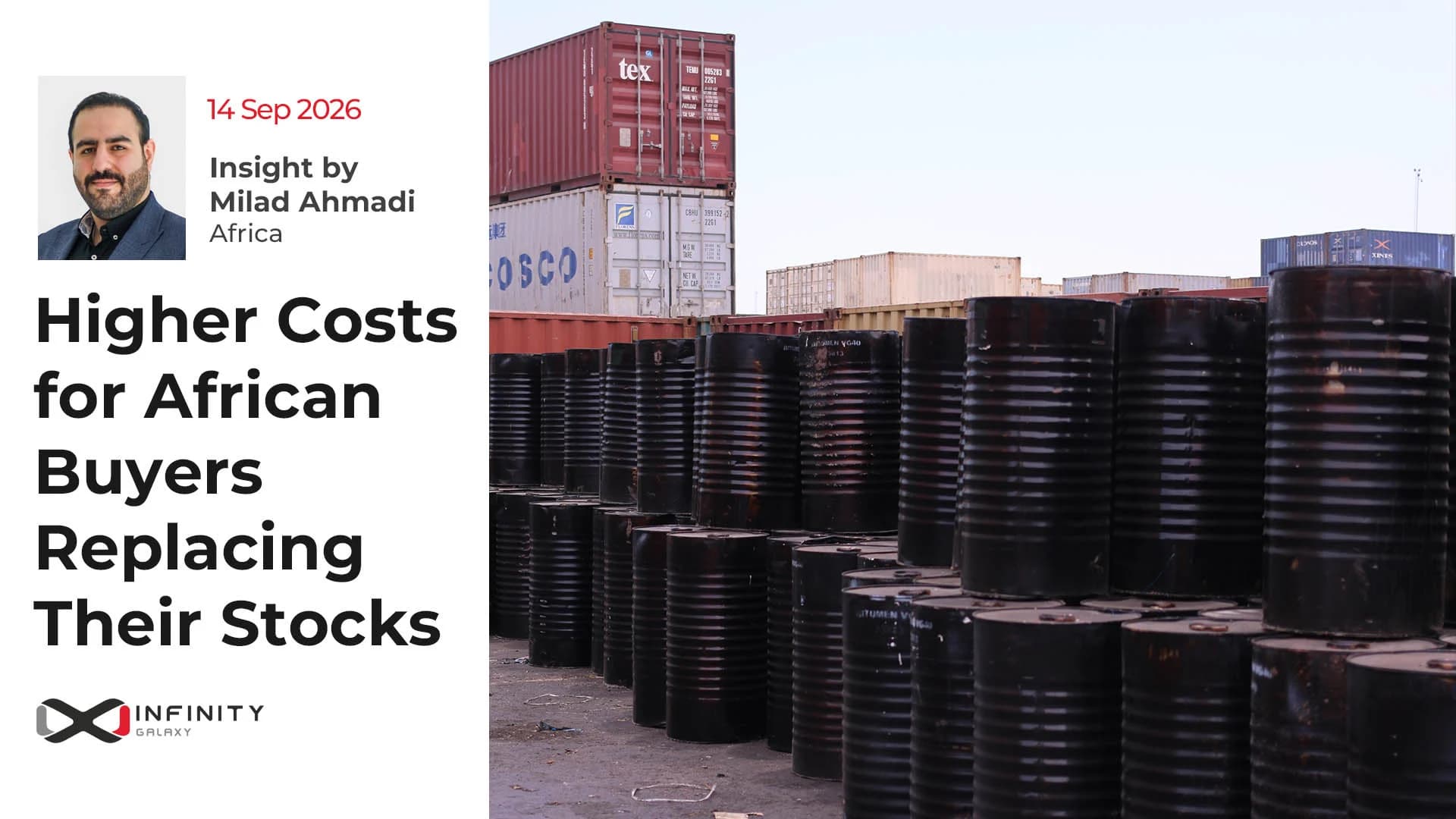
Tensions in the Middle East have pushed crude oil and HSFO prices higher. This means African buyers and traders now need to pay more to buy new cargoes and replace their current stocks.
However, the impact is not uniform across the region. In West Africa, rainfall continues to weigh on demand. In East Africa, the main challenge remains finding supply that is commercially and logistically executable. In South Africa, the approach of the warmer season is gradually supporting a recovery in paving activity.
Nigeria: Higher Import Prices, but Buyers Remain Cautious
Market discussions indicate that CFR Lagos has increased by around $13/MT from last week, with negotiable offers now mainly seen in the mid-$740s to low-$750s/MT CFR range.
However, the increase is primarily driven by higher crude, HSFO and replacement costs rather than a significant increase in demand. Heavy rainfall continues to slow project execution and consumption, and many buyers are still not in a hurry to secure prompt cargo.
At the same time, cargo flows into Warri are continuing, meaning availability has not come to a complete stop.
Market View:
For Nigeria, buyers should distinguish between the market price and real demand. Import replacement costs have increased, but if a cargo does not come with a firm ETA, there is still room for negotiation.
Ghana & Ivory Coast: Prices Higher, but Supply Is Starting to Recover
CFR Ghana and FOB Abidjan have also moved higher compared with last week, but supply conditions are showing better signs than they did several weeks ago.
Loading activity from Abidjan has resumed, while a new crude cargo is reportedly expected in late September. If it arrives as scheduled, it could improve production and export availability as the dry season begins in October.
Ghana is also expected to receive a cargo from Greece in mid-September, after a period in which the market had received fewer direct cargoes from Abidjan.
Market View:
For Ghana and Ivory Coast, the current price increase does not necessarily indicate a prolonged shortage. Buyers with delivery windows from October onward should factor the expected new supply into their negotiations rather than focusing only on current replacement costs.
West Africa: Rainfall Limits Demand, but Cargo Flow Continues
Nigeria, Ghana, Cameroon and Ivory Coast remain affected by the rainy season, with further rainfall expected across parts of West and Central Africa next week.
Nevertheless, cargo flows from the Mediterranean to Lome, Gabon, Ghana and Nigeria continue, and the regional market is not facing an outright supply shortage.
Spanish export availability has also improved, with some sellers offering lower premiums relative to HSFO.
Market View:
West Africa is currently not a market of absolute shortage. It is a market where weak demand is meeting higher replacement costs. Buyers with clearly defined volumes and delivery requirements can still negotiate competitive offers.
Kenya, Uganda & Tanzania: Prices Slightly Lower, but Executable Supply Is More Valuable
Unlike West Africa, CFR drum assessments for Mombasa and Dar es Salaam have edged lower this week.
Iranian export prices have also softened, with bulk FOB Bandar Abbas now generally seen around the high-$290s to low-$300s/MT, while drum offers are around the high-$380s to low-$400s/MT.
However, execution remains the main challenge. Restrictions around the Strait of Hormuz continue to push East African buyers and suppliers toward Oman, Turkey and other alternative routes.
Bulk Oman is being offered at around $500/MT FOB, although no confirmed transaction has been reported so far. Container freight from Oman to East Africa can be around $125–150/MT, while the Bandar Abbas/Jebel Ali route is still assessed at approximately $255–270/MT.
Market View:
In East Africa, a lower Iranian FOB price is only attractive on paper if shipping and payment routes cannot be executed. Buyers should evaluate origin + freight + payment route + loading confirmation as one commercial package.
Kenya & Uganda: Demand Is Moving Ahead of Available Supply
Demand for both bulk and drummed bitumen in Kenya, Uganda and the DRC remains relatively healthy.
One important development this week is that approximately 5,700 MT of bulk cargo previously imported from Turkey into Mombasa has effectively been sold for September and October delivery.
At the same time, more projects are expected to move into execution from October onward, potentially increasing regional consumption.
Market View:
For buyers in Kenya and Uganda, waiting for another few dollars of price reduction may not always be the best strategy. When actual cargo, a confirmed loading window and a reliable delivery schedule are available, execution value can be more important than the headline price.
DRC & South Sudan: Demand Exists, but the Route Determines the Deal
End-user demand across inland markets remains active, while incoming supply through Mombasa and Dar es Salaam continues to play an important role for these destinations.
Any limitation in coastal availability or trucking capacity can quickly affect both landed cost and delivery time.
Market View:
In DRC and South Sudan, offers should be evaluated based on actual route availability. A few dollars of difference at origin have limited value if the selected route later creates delays or truck availability problems.
South Africa: The Buying Season Is Gradually Returning
South Africa presents a different picture this week. Several large cargoes have arrived in Durban and supply remains healthy, while paving activity is gradually improving as the warmer season approaches.
The market is still not uniform across the country. Weather conditions in the southern regions are becoming more favorable for project execution, while activity in some northern areas remains relatively weaker.
New cargoes from Turkey, Oman and West Africa have also arrived in Durban or are currently on the way.
Market View:
South Africa is no longer simply a surplus market. Buyers still have negotiating leverage, but as demand gradually improves, prompt availability may become more valuable in the coming weeks.
Africa Market Summary by Milad Ahmadi
This week, the African bitumen market is showing three different realities:
West Africa: Replacement costs are higher, but the rainy season continues to limit demand.
East Africa: Final prices are slightly lower, but executable supply remains constrained and alternative routes are still expensive.
Southern Africa: Supply remains healthy, while demand is gradually returning with the approaching paving season.
The Key Message This Week
The African bitumen market can no longer be understood through a single price number.
Available Cargo + Origin + Freight + Loading Window + Payment Route + Delivery Certainty
All of these factors need to be evaluated together.
If you are active in an African market, send me your destination country, packing preference, approximate volume and required delivery timing, and we can assess which origin and route are currently the most executable and negotiable for your requirement.
Comments
Share your thoughts...
More Reports
Curious to see more, discover more articles, and stay up-to-date?