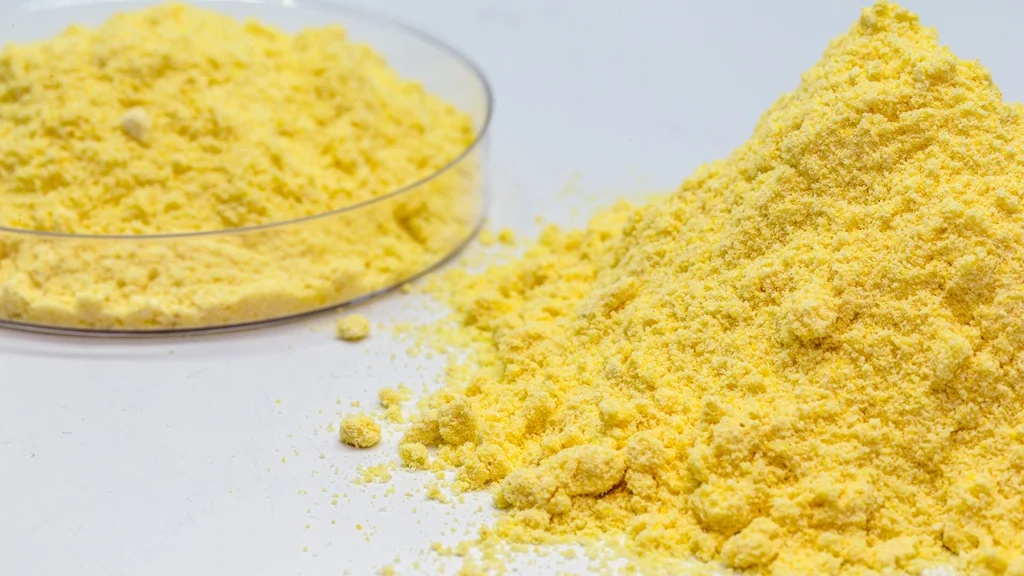
Sulfur
Types of Sulfur: Powder, Lump, Granular, Flakes and More
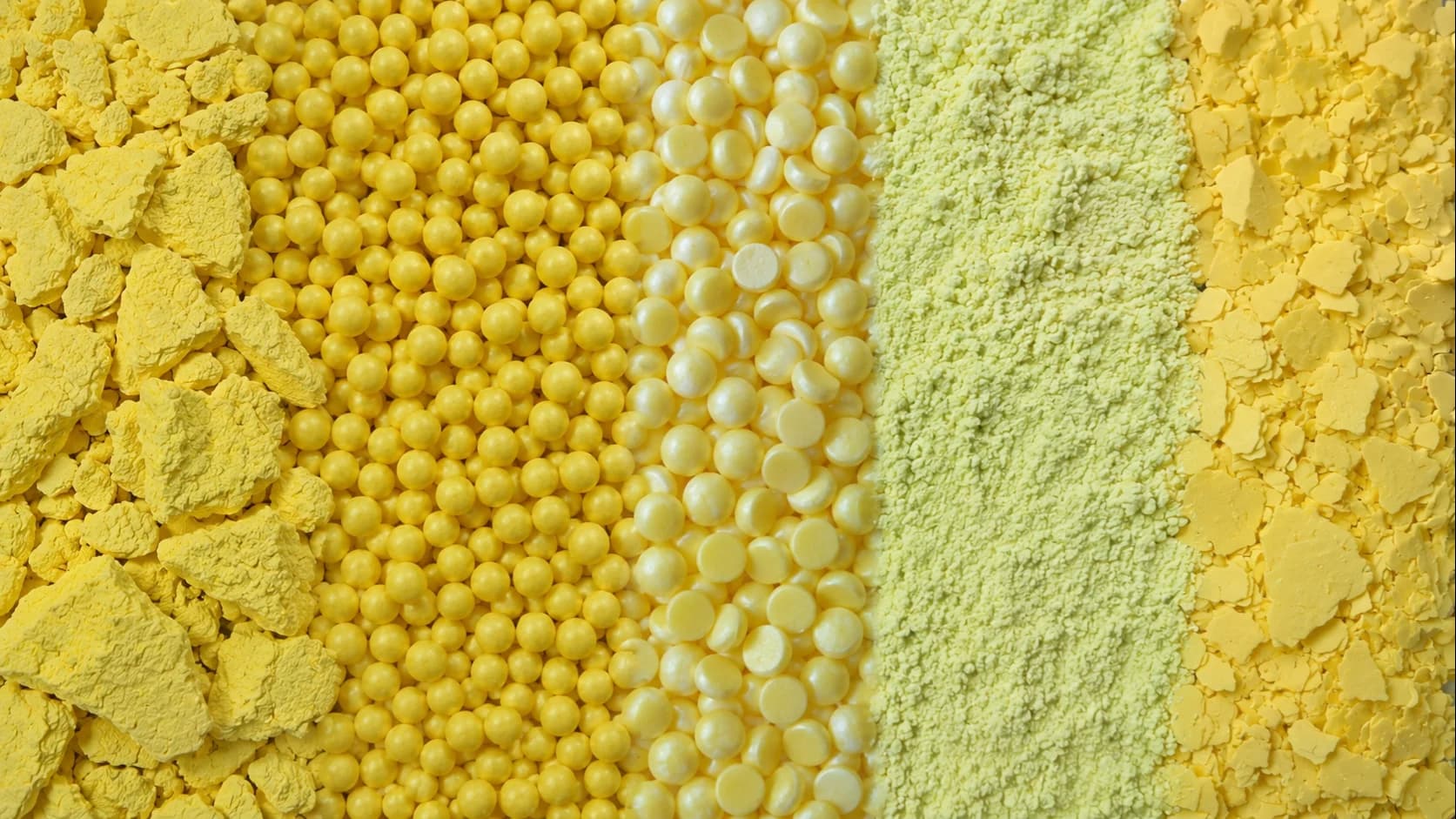
Sulfur comes in more than one commercial form. You may see it as a fine powder, large lumps, flakes, granules, or pastilles. You may also come across products such as sulfur bentonite 90 and sulfur 90 WDG. But are all these products chemically different? Not always. In many cases, the sulfur is still elemental sulfur....

- What Makes Different Types of Sulfur Different?
- Main Types of Sulfur at a Glance
- Powdered Sulfur
- Lump Sulfur
- Sulfur Flakes
- Pastille Sulfur
- Granular Sulfur
- Sulfur Bentonite 90: What Does “90” Mean?
- What Is Sulfur 90 WDG?
- Powdered vs Granular vs Lump vs Flakes vs Pastilles
- Which Sulfur Forms Are Used as Fertilizer?
- How Should You Choose a Sulfur Form?
- What Should Buyers Check Before Ordering Sulfur?
- Looking for a sulfur product for your next shipment?
Sulfur comes in more than one commercial form.
You may see it as a fine powder, large lumps, flakes, granules, or pastilles. You may also come across products such as sulfur bentonite 90 and sulfur 90 WDG.
But are all these products chemically different?
Not always.
In many cases, the sulfur is still elemental sulfur. What changes is the physical form, particle size, formulation, or production method. These differences can affect handling, application, surface area, and how the product behaves in its intended use.
For example, powdered sulfur can be supplied in different particle sizes, while lump sulfur comes in much larger pieces. Granular and pastille sulfur are formed into specific shapes for easier handling. Sulfur bentonite 90 is a formulated product that combines sulfur with bentonite.
In this guide, we look at the main types of sulfur, explain what makes them different, and show what buyers should check before choosing a sulfur product.
What Makes Different Types of Sulfur Different?
The first thing to know is that “sulfur type” does not always mean a different chemical substance.
Many commercial sulfur products contain elemental sulfur, but suppliers offer them in different physical forms. Powdered sulfur has very small particles, while lump sulfur consists of large solid pieces. Granular and pastille sulfur are formed into smaller, more regular pieces.
Some products are also formulated products, rather than simply a different physical form. Sulfur bentonite 90, for example, commonly contains about 90% sulfur and 10% bentonite.
So, when comparing sulfur products, it is useful to look at four things:
- Chemical composition
- Particle size
- Physical form
- Intended use
This is why two sulfur products can contain a similar amount of sulfur but still have different handling or application characteristics.
In simple terms:
Same sulfur does not always mean the same product.
Main Types of Sulfur at a Glance
| Sulfur Type | Physical Form | Main Feature | Common Uses |
|---|---|---|---|
| Powdered Sulfur | Fine powder | Very small particles | Agriculture, chemicals, industrial uses |
| Sublimed Sulfur | Fine powder | Made by sublimation | Agricultural and specialty applications |
| Lump Sulfur | Large pieces | Minimal forming | Industrial use and bulk handling |
| Crushed Lump Sulfur | Crushed pieces | Coarser than powder | Industrial and bulk applications |
| Sulfur Flakes | Thin flakes | Easy to handle | Industrial and chemical uses |
| Pastille Sulfur | Small formed pieces | Uniform size, low dust | Agriculture and fertilizer |
| Granular Sulfur | Granules | Easier spreading | Agriculture and fertilizer |
| Sulfur Bentonite 90 | Granules/pastilles | 90% sulfur + bentonite | Soil sulfur fertilizer |
| Sulfur 90 WDG | Water-dispersible granules | Designed to disperse in water | Agricultural applications |
Powdered Sulfur
Powdered sulfur consists of elemental sulfur in a fine particle form. Because the particles are small, powdered sulfur has a much larger surface area than larger sulfur particles.
This can make it more reactive than larger particles, but it also makes the product more difficult to handle. Fine sulfur can create dust during loading, transfer, and application, so users must follow proper handling and storage practices.
Several industries use powdered sulfur, including agriculture and chemical processing. In agriculture, users may choose fine sulfur when they need faster conversion of elemental sulfur. However, very fine sulfur is not always the easiest form to spread.
What Is Sublimed Sulfur?
Sublimed sulfur is a fine sulfur product made through a sublimation process.
In simple terms, sulfur is changed into vapor and then cooled so that it becomes solid again. The resulting product is a fine form of sulfur. It is also known as flowers of sulfur.
The important point is that “sublimed” and “powdered” do not describe exactly the same thing.
- Powdered sulfur mainly describes the physical form or particle size.
- Sublimed sulfur describes how the sulfur is produced and the resulting fine product.
This means sublimed sulfur can be supplied as a powder, but not every powdered sulfur product is sublimed sulfur.
For buyers, this distinction matters when checking the product specification and production method.
Lump Sulfur
Lump sulfur is sulfur supplied as large solid pieces rather than fine powder or regular granules.
Its main difference from powdered sulfur is particle size. Large pieces have much less surface area than fine particles, so they behave differently in applications where surface area and reaction speed are important.
Lump sulfur is common in industrial and bulk supply chains. Buyers may also process or crush it into smaller pieces depending on the next stage of use.
For bulk buyers, the required size range, sulfur purity, moisture, impurities, packaging, and loading method can all be important.
What Is Crushed Lump Sulfur?
Crushed lump sulfur is lump sulfur that has been broken or crushed into smaller pieces.
It is larger than fine powder but smaller than the original lump material. The exact size range depends on the product specification.
This form can be useful when the buyer needs a smaller sulfur particle size but does not require fine powder.
Sulfur Flakes
Sulfur flakes are thin pieces of solid sulfur.
Manufacturers can produce them by cooling molten sulfur on a surface and removing the solid sulfur from it. The result is a thin, formed product rather than a powder or large lump.
Flakes can be easier to handle than fine powder and provide more surface area than large sulfur pieces.
Depending on the specification and application, sulfur flakes can be used in industrial processes and some agricultural products.
For buyers, it is important to remember that “flake” describes the physical form, not a different sulfur chemistry.
Pastille Sulfur
Pastille sulfur is sulfur formed into small, relatively uniform pieces.
Compared with fine powder, pastilles are generally easier to handle, store, and transport. Their formed shape can also help reduce the dust associated with very fine sulfur.
Pastilles can be used in different sulfur applications, including some fertilizer products.
However, pastille and granular sulfur should not be treated as completely different chemical products. The main differences are usually related to shape, size, and the forming process.
Granular Sulfur
Granular sulfur is elemental sulfur formed into granules with a controlled particle size.
One of its main practical advantages is handling. Granules are generally easier to move, store, and spread than very fine sulfur powder.
Particle size also matters in agricultural applications. Elemental sulfur must first be converted in the soil before plants can take it up. Smaller sulfur particles provide more surface area for this process, while larger particles can react more slowly.
This creates an important balance:
Smaller particles → more surface area and potentially faster conversion
Larger particles → easier handling and spreading
The best particle size therefore depends on the application rather than simply being “smallest is best.”
Sulfur Bentonite 90: What Does “90” Mean?
Sulfur bentonite 90 is commonly a sulfur fertilizer product containing about 90% elemental sulfur and 10% bentonite.
The bentonite does more than change the product composition. It also helps the sulfur break down after it comes into contact with moisture in the soil.
When the bentonite absorbs water, it expands and helps the sulfur granule break apart into smaller particles. This increases the surface area available for the conversion of elemental sulfur in the soil.
This gives sulfur bentonite an important practical advantage:
Easy to handle as a formed product → breaks down into smaller sulfur particles in moist soil.
Is Sulfur Bentonite the Same as Elemental Sulfur?
No, not exactly.
Sulfur bentonite contains elemental sulfur, but it is a formulated product that also contains bentonite.
So, while powdered sulfur, lump sulfur, flakes, and many granular sulfur products may describe different physical forms of sulfur, sulfur bentonite describes a product with an additional material in its formulation.
The exact sulfur and bentonite percentages should always be checked in the product specification.
What Is Sulfur 90 WDG?
WDG usually means water-dispersible granule.
This is different from simply supplying elemental sulfur as a dry granule. A WDG product is formulated so that its particles can disperse in water for the intended agricultural application.
This is why:
Sulfur 90 granular ≠ automatically Sulfur 90 WDG
The two products may have a similar sulfur content, but they can have different formulations and intended applications.
If a buyer asks for “Sulfur 90,” the name alone may not be enough.
The buyer should confirm:
- Sulfur content
- Physical form
- Particle size
- Bentonite content, if applicable
- WDG or non-WDG formulation
- Intended application
This small difference in product naming can prevent a buyer from requesting the wrong specification.
Powdered vs Granular vs Lump vs Flakes vs Pastilles
| Feature | Powder | Granular | Lump | Flakes | Pastilles |
|---|---|---|---|---|---|
| Particle size | Very fine | Controlled granules | Large pieces | Thin pieces | Small formed pieces |
| Dust | Higher | Lower | Low to moderate | Moderate | Low |
| Handling | More difficult | Easy | Easy in bulk | Relatively easy | Easy |
| Surface area | Very high | Medium | Low | Medium | Medium |
| Spreading | More difficult | Easier | Not suitable for uniform spreading | Depends on use | Easier |
| Typical advantage | High surface area | Easy application | Bulk handling | Formed industrial product | Uniform handling |
Which Sulfur Forms Are Used as Fertilizer?
Several sulfur forms can be used in agriculture, but they do not work in exactly the same way.
- Powdered sulfur
Fine sulfur provides a high surface area. This can be useful when a finer particle size is needed.
- Granular sulfur
Granules are easier to handle and spread than very fine powder. Their particle size also affects how quickly the sulfur can convert in soil.
- Sulfur bentonite
Sulfur bentonite combines elemental sulfur with bentonite. The bentonite helps the product break down after contact with moisture.
What happens to elemental sulfur in soil?
Plants do not directly take up elemental sulfur in its elemental form.
Soil microorganisms first convert elemental sulfur into sulfate. Plants can then absorb the sulfate.
This is why particle size, formulation, soil conditions, and application method all matter when selecting an agricultural sulfur product.
How Should You Choose a Sulfur Form?
Choose sulfur based on the application and product requirements, not only the product name.
If you need very fine particles
Powdered sulfur may be suitable when a fine particle size and high surface area are important.
In this case, confirm the required mesh or particle size with the supplier.
If easy handling and spreading are important
Granular or pastille sulfur may be easier to handle and distribute than fine powder.
The required particle size and product shape should still be confirmed.
If the sulfur will be used directly as a fertilizer
Particle size, sulfur content, application method, and the way the product breaks down in soil become important.
For sulfur bentonite products, the bentonite content and breakdown behavior are also relevant.
If the sulfur will be used in another industrial process
The buyer may need to focus more on sulfur purity, particle size, moisture, impurities, physical form, and the next processing step.
If a formulated product is required
If the buyer needs sulfur bentonite 90 or sulfur 90 WDG, a generic elemental sulfur product is not enough.
The exact formulation should be included in the purchase specification.
What Should Buyers Check Before Ordering Sulfur?
This is where sulfur selection becomes a buying decision rather than only a technical question.
Before ordering sulfur, do not check only the sulfur percentage.
A buyer should confirm:
- Sulfur content
- Physical form
- Particle or granule size
- Mesh size, when buying powder
- Moisture
- Ash and other impurities
- Bentonite content, if applicable
- Product formulation
- Packaging
- ents
For example, a request for:
“90% sulfur”
may still be incomplete.
The buyer may need to specify whether they need:
90% sulfur granular, sulfur bentonite 90, or sulfur 90 WDG.
Likewise, a request for:
“sulfur powder”
may need a specific mesh or particle-size requirement.
The more clearly the buyer defines the product, the easier it is to compare supplier offers and avoid receiving a product that does not match the intended use.
Looking for a sulfur product for your next shipment?
See our sulfur product specifications, available forms, packaging options, and supply details.
Comments
Share your thoughts...
Latest
From the blog
Curious to see more, discover more articles, and stay up-to-date?