Bitumen
Weekly Bitumen Report: Six Months into the War, the Crisis Is No Longer Temporary; Brent Near $92 as Supply Chains Are Being Redrawn
Six months into the war, disruptions around Hormuz are reshaping global energy trade. Brent neared $92 as longer routes, shifting suppliers, and financial restrictions increased costs. Bitumen markets remained mixed, with weak demand in Asia and Europe and continued shipping challenges for Iran exports.

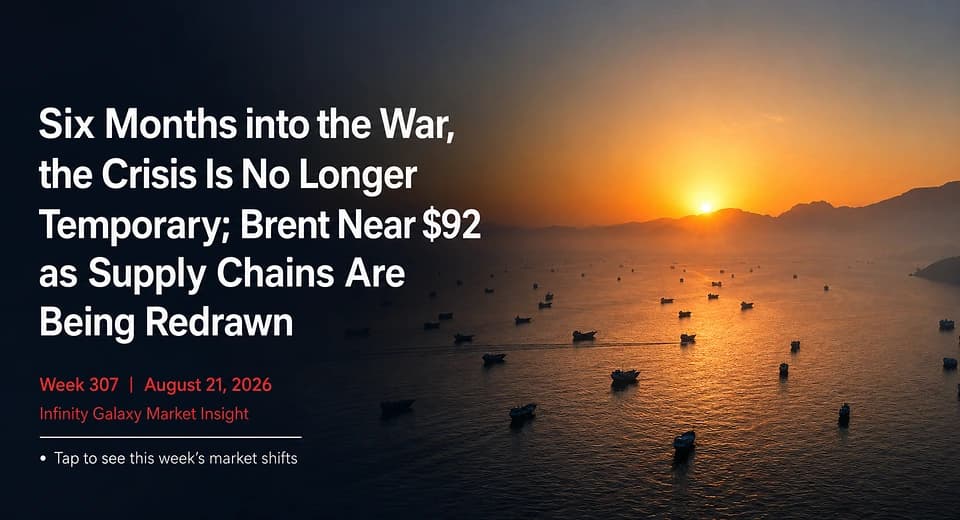
The energy market confronted a new reality this week: a disruption that began nearly six months ago as a wartime shock is gradually becoming part of the structure of global trade. The 60-day window for progress in the US-Iran agreement expired without a clear outcome, while Washington and Tehran still offer conflicting accounts of the status of Hormuz Strait. The US considers the strait open, while Iran maintains that it remains closed. In practice, Kpler data recorded only six vessel transits in a single day during the middle of last week.
Pressure Moves from the Persian Gulf into the Economy
At the same time, the United States has taken its economic pressure campaign into a new phase. On 20 August, President Trump announced what he called an “Economic D-Day” against Iran, describing it as an exceptionally severe economic campaign. Full implementation details are still unclear, although the US Treasury had already signalled measures that Treasury Secretary Scott Bessent described as unprecedented in the history of economic isolation.
Meanwhile, the UAE suspended financial and commercial transactions with Tehran after reporting the detection of two missiles allegedly linked to Iran, an allegation Tehran has denied. The combination of financial pressure, the maritime blockade, and disruption involving one of the region’s most important commercial hubs means that the risk surrounding Iran trade is extending beyond shipping into payments, financial settlement, and access to regional trading networks.
Ships Are Not Waiting for the Crisis to End; New Trade Routes Are Emerging
Perhaps the most important change is now taking place inside the supply chain itself. Longer transit times, rerouted cargoes, and changes in global sourcing patterns are increasing costs while simultaneously creating new opportunities for some countries. US and Indian refiners, for example, have gained a larger share of global petroleum product exports.
These are no longer short-term reactions to a few days of disruption. The global energy supply chain is increasingly finding alternative routes and suppliers in response to a crisis that markets now expect could last much longer.
Brent Oil Returns to Nearly $92
The Brent Oil Price reflected the same shift in expectations. After ending the previous week around $87-$88 per barrel, Brent climbed to approximately $91.9 per barrel on Thursday, 20 August, reaching its highest level since late July 2026.
Continued restrictions through Hormuz Strait, the lack of political progress, and renewed tensions between Iran and the UAE were among the main drivers of the rise, while higher US crude inventories limited a sharper increase in the Oil Price.
East Asia Bitumen Market: Fuel Oil Rises Faster than Bitumen
The pressure in East Asia is particularly visible in the narrowing gap between fuel oil and bitumen. According to international market reports, Singapore 180 CST fuel oil rose to around $610 per metric ton, while Singapore Bitumen traded near $628 per metric ton and South Korea Bitumen around $538 per metric ton.
Fuel oil therefore rose faster than bitumen this week, increasing cost pressure while buyers continued to resist further Bitumen Price increases. The latest Argus assessments also indicate that rainfall continues to restrict domestic consumption in the China Bitumen Market, while southern China is helping compensate for regional supply shortages with export offers of around $620–$630 per metric ton.
India Bitumen: Small Refinery Price Increase, but No Major Change in Demand
The monsoon continues to keep the India Bitumen Market relatively quiet. Following the price reductions at the beginning of August, BPCL and HPCL partially reversed the decline from 16 August, increasing VG30 prices by around $3.5 per metric ton and VG40 by approximately $4 per metric ton.
For now, this appears to be a limited price correction rather than the beginning of a stronger upward cycle. Domestic demand remains weak, while freight from the Persian Gulf to India continues to be both expensive and exposed to significant shipping risk.
European Bitumen Rises with Fuel Oil, but Summer Holidays Keep the Market Quiet; Bahrain Holds at $550
In Europe, higher fuel oil values lifted export cargo prices, although bitumen premiums over fuel oil declined as summer holidays, stronger supply, and limited buying activity continued to restrict the market. The overall European Bitumen Price range, from the Mediterranean to northern Europe, remained at approximately $510-$530 per metric ton.
Bahrain Bitumen also remained unchanged at around $550 per metric ton FOB.
Iran Bitumen: Prices Exist, but the Shipping Route Remains Restricted
In Iran, as in previous months, prices continue to be quoted, but actual export execution remains slow, difficult, and subject to significant delays. Some exporters have shifted toward land routes or shipments through Turkey, adding both time and cost.
After nearly six months of disruption, the key question for the Iran Bitumen Market is no longer simply, “What is the price?” The more important questions are which route can actually be used, at what cost, and within what realistic delivery timeframe.
Insight from Razieh Gilani: Every Price Has an Expiry Date
In a market where shipping conditions, oil prices, and even payment routes can change within hours, a good price is not simply the lowest number. It is a price the seller understands- how long it remains executable and how much certainty actually stands behind it.
Credibility today means being available, responding quickly, and ensuring that when conditions change, the customer hears it directly from the seller rather than discovering it through the market. In this environment, trust is no longer an additional service surrounding the transaction; it has become part of the transaction itself.
For current bitumen prices, cargo availability, and reliable shipping guidance, Contact Us.
Comments
Share your thoughts...
More Reports
Curious to see more, discover more articles, and stay up-to-date?