East Asia Bitumen Market
East Asia Bitumen Market: September Supply Becomes More Limited, but Demand Remains Uneven
East Asia’s bitumen market faces limited September cargo availability, while demand remains uneven across key markets. Singapore and Thailand stay constrained, China gains a larger supply role, and buyers increasingly weigh origin, grade, freight, and execution alongside price.

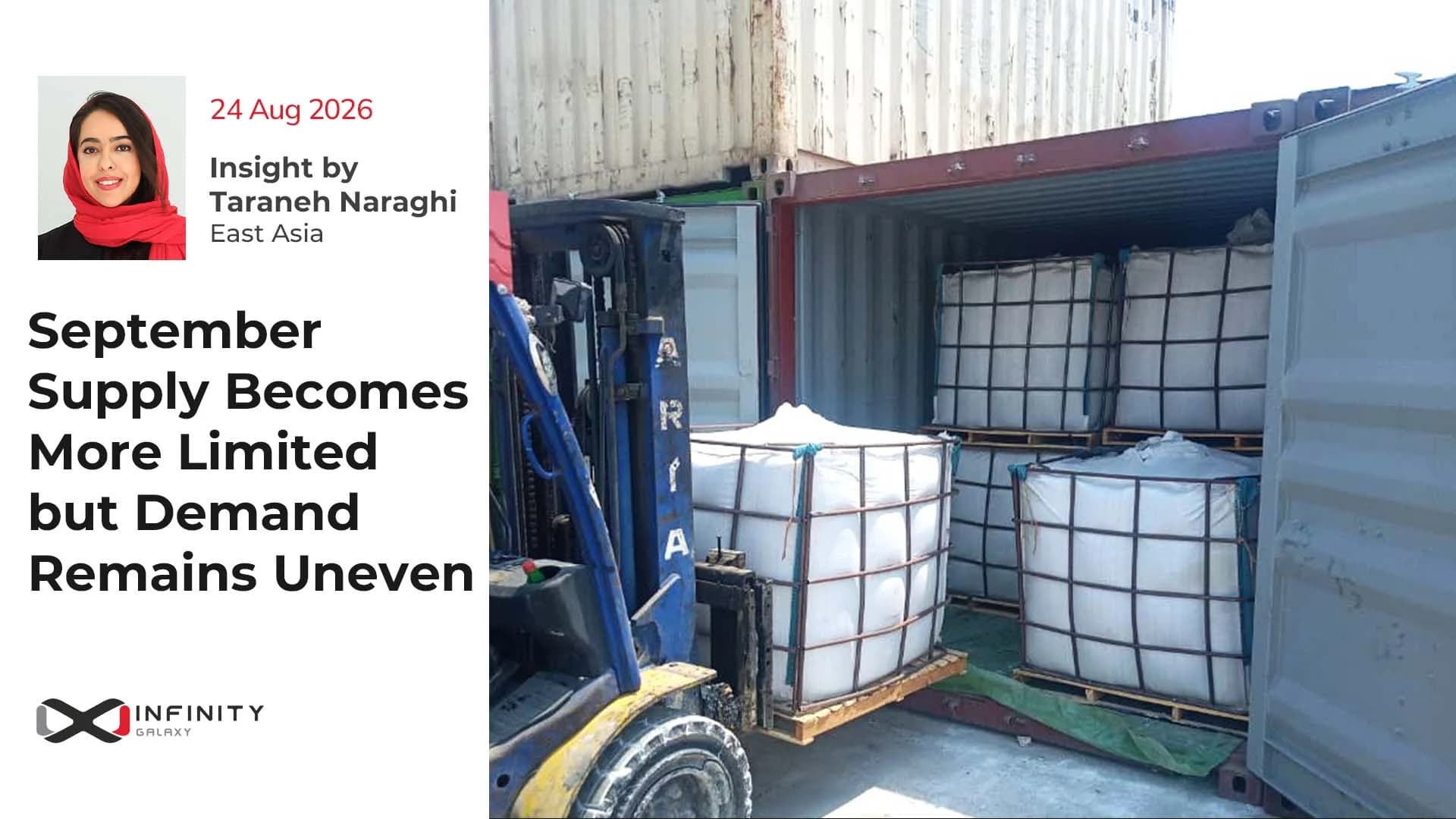
Commercial traffic through the Strait of Hormuz has not yet returned to normal, and some cargoes are still moving only under special approvals. At the same time, Brent crude has remained above USD 90/bbl in recent days.
For the East Asian bitumen market, the impact is currently seen more in refinery feedstock limits, cargo availability, freight costs, and execution risks than in a broad increase in demand.
Singapore | Prices Remain High, but Availability Is Now the Main Issue
Singapore bitumen supply remains tight, and only a limited number of sellers are willing to offer spot volumes for September loading. Current market levels are around USD 630–650/MT FOB, while buyers with specific origin or loading requirements need to negotiate more seriously to secure workable cargoes.
Compared with last week, the price increase in Singapore has been limited, but availability remains tight. In this market, saving a few dollars is not always the main concern. Having a real cargo, a reliable loading window, and workable freight is becoming more important.
Malaysia | Quiet Market, with Imports Needing a Clear Advantage
Bitumen demand in Malaysia remains at a low to medium level. No major new projects have yet moved into the main consumption stage, while occasional rainfall continues to slow some road maintenance and repair work.
Domestic supply is enough for current market needs. Therefore, imported cargoes become attractive only when they offer a clear advantage in terms of price, delivery timing, or execution. At present, there is no strong prompt buying pressure from Malaysia.
Indonesia | Demand Exists, but Budgets Limit Buying Interest
Demand in western Indonesia, especially in the main consuming markets, remains relatively stable, while consumption in the eastern part of the country is still weaker.
Some buyers still have import requirements for August and September cargoes, but high seaborne prices and the weaker rupiah are limiting their buying power.
Current workable levels are mostly seen around USD 660–680/MT CFR. Indonesia should therefore not be considered a completely inactive market. Demand is still there, but buyers have become more selective. Deals are more likely when the origin, freight, and final price fit the project budget.
Thailand | September Supply Remains Tight and Sellers Are More Cautious
September export availability from Thailand remains limited. Heavy feedstock shortages and the use of lighter crude grades have reduced bitumen yields. Together with relatively healthy domestic demand, this leaves limited room for additional exports.
Current offers are mainly around USD 640–650/MT FOB Thailand, and in some cases sellers do not have any open volume to offer.
For buyers who specifically need Thai bitumen for technical or commercial reasons, availability and loading window should be confirmed first, followed by price negotiations.
Vietnam | Most Buyers Have Already Covered Their September Needs
With weather conditions improving, bitumen consumption is expected to gradually recover in the coming weeks. However, there has still been no clear increase in spot buying activity, as many buyers have already covered a large part of their requirements for the first half of September.
Levels around USD 650–660/MT CFR remain among the workable levels for both northern and southern Vietnam, while buyers continue to resist higher prices.
In this situation, cargoes from South China remain a practical option for the market and can be more competitive than Singapore-origin supply in some deals.
South Korea | Price Advantage over Singapore Is Narrowing
South Korean export prices strengthened again this week, with market levels reaching around USD 569–592/MT FOB.
South Korea is still cheaper than Singapore on an absolute basis, but the price gap has narrowed compared with previous weeks.
Availability is also not very open, while grade has become more important. Not all Korean grades can be used as direct alternatives in China or Southeast Asia.
South Korea therefore remains an origin worth considering, but buyers should not make decisions based only on the assumption that Korean cargoes are cheaper. Grade, destination, and freight all need to be considered together.
China | A Weak Domestic Market Creates a Stronger Export Origin
Domestic bitumen demand in China remains weaker than expected for this time of year. This has allowed South China to continue playing an important role in supplying Southeast Asian markets.
In recent weeks, Chinese cargoes have moved into Vietnam, Malaysia, and Indonesia, helping to cover part of the supply gap caused by limited Singapore availability.
South China export levels are now mainly discussed at around USD 630/MT FOB and above, with part of the September supply already committed.
China is therefore no longer simply a cheaper alternative. It has become a real supply origin in the regional market, and for each destination, its CFR level should be compared directly with Singapore, Thailand, and South Korea.
Market Insight by Taraneh Naraghi from Infinity Galaxy
The market message this week is clear: supply remains tight, but regional demand is still not strong enough to accept every price increase.
Singapore and Thailand remain tight on the supply side. South Korean prices have moved higher compared with previous weeks, while China is now covering part of the regional supply gap.
At the same time, Malaysia remains quiet, Indonesia is buying within tight budget limits, and Vietnam has already covered a large part of its September requirements.
For buyers, the best deal this week is not necessarily the lowest number on paper. The right combination of origin, grade, reliable loading, and workable freight is what determines whether an offer is actually worth pursuing.
Contact with Taraneh
Send a message on WhatsApp to receive further information.
Comments
Share your thoughts...
More Reports
Curious to see more, discover more articles, and stay up-to-date?