East Asia Bitumen Market | Oil Back Above $96; Supply Tightens, but Buyers Are Still Not Chasing the Market
East Asia bitumen supply is tightening as oil prices rise, but buyers remain cautious. Singapore, Thailand and South Korea face limited availability, while China prices higher. Indonesia and Vietnam retain demand, with origin, freight and execution becoming increasingly important.

The US-Iran conflict intensified again toward the end of the week, pushing Brent crude to around $93/bbl in the latest trading sessions. At the same time, commercial traffic through the Strait of Hormuz remains significantly below normal levels, while reports of a recent attack on an Iranian tanker near Kharg Island have once again increased concerns over freight, cargo execution, and refinery feedstock availability.
For the East Asian bitumen market, the immediate impact of these developments is being felt more through availability, freight costs, and cargo execution risks than through a broad-based increase in demand.
This week’s market assessment shows that sellers across several key origins have less room to reduce prices, while buyers remain reluctant to accept higher offers simply because crude prices have moved higher. Compared with last week, the price gap between origins has narrowed, making origin selection increasingly complex.
Singapore | Tight October Availability Keeps Sellers in Control
Spot availability from Singapore for October remains limited, and buyers with firm requirements have had to move their negotiation levels higher.
Negotiable levels this week are generally assessed at around $645–660/MT FOB Singapore. However, even at the upper end of this range, sellers are showing limited urgency to conclude deals.
As seen last week, the key issue in Singapore is no longer pricing alone. Cargo availability and loading windows are becoming increasingly important in determining which negotiations can actually be executed.
Malaysia | Soft Demand, with Domestic Supply Still Preferred
The Malaysian market remains in the weak-to-moderate range, while unfavorable weather conditions in some areas have also slowed road construction activity.
Compared with last week, there has been no significant new buying pressure. As long as domestic supply remains sufficient, buyers have limited incentive to purchase higher-priced imported cargo.
For foreign suppliers, Malaysia becomes more attractive when they can offer a clear advantage not only in price, but also in delivery timing and confirmed availability.
Indonesia | September Requirements Remain, but the Buyer-Seller Gap Is Still Wide
Some Indonesian importers still have outstanding requirements for September. However, budget limitations and higher seaborne cargo costs continue to prevent buyers from chasing the market without limits.
Current buyer indications are mainly around $690–700/MT CFR, while some offers remain above this range.
Unlike a completely weak market, Indonesia still has genuine demand. However, transactions are more likely to materialize among buyers with urgent requirements, approved budgets, and clearly defined discharge plans.
CIS & Central Asia | Demand Remains, but Execution and Final Delivered Cost Are Key
The CIS and Central Asian bitumen market continues to show meaningful demand for overland supply. However, buyers have become increasingly sensitive to the final delivered cost, border-crossing expenses, and the reliability of transportation execution.
Lower indications from Iran suggest that competition to maintain overland export flows has intensified. At the same time, the absence of widespread new transactions in some packaging segments indicates that buyers are still entering the market selectively.
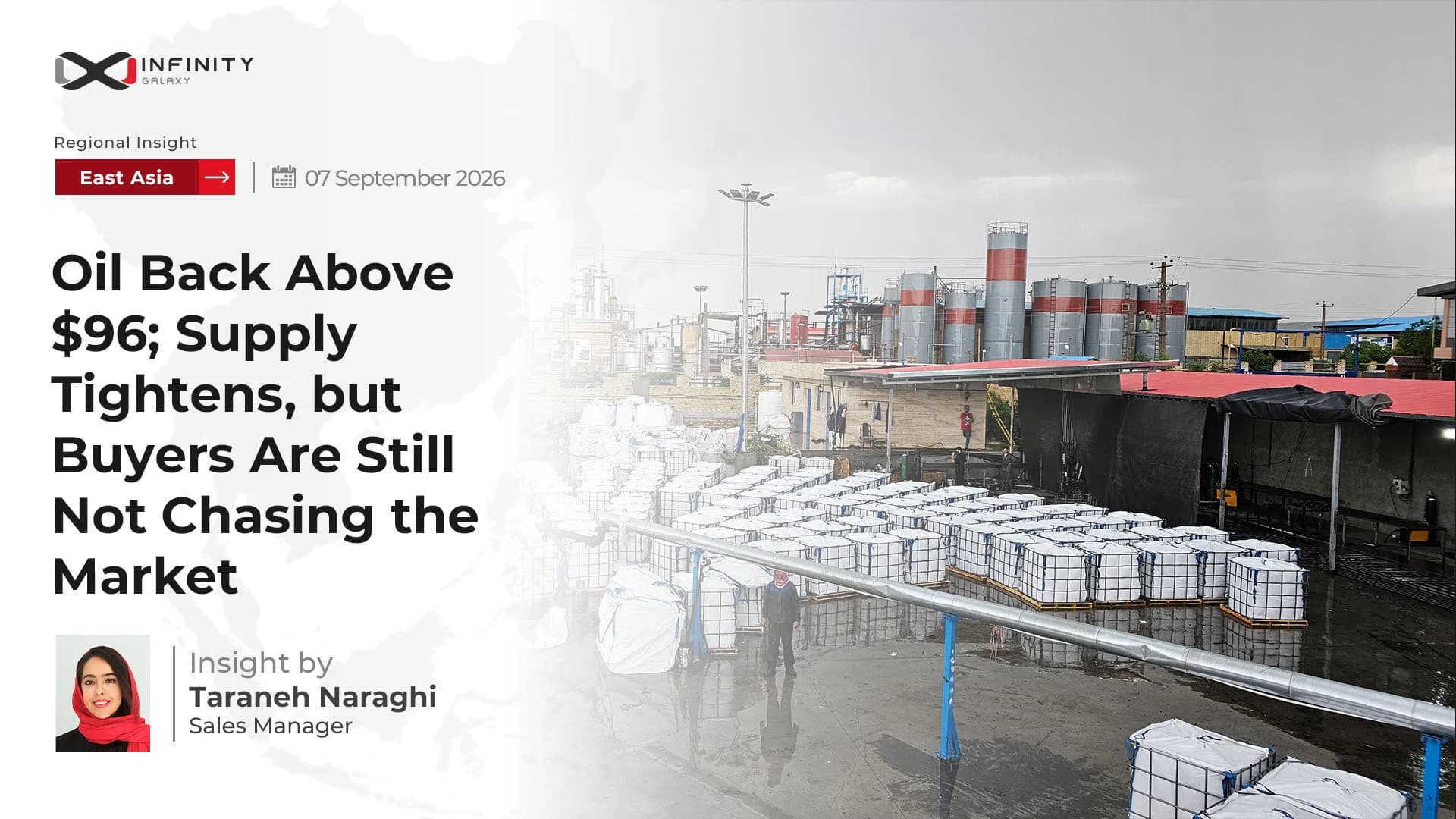
Infinity Galaxy remains focused on providing practical and reliable supply routes and can offer Iranian and Iraqi bitumen to CIS and Central Asian destinations in 1-MT Jumbo Bags inside Steel Cages, with transportation plans tailored to the destination.
Under current market conditions, the key advantage is not simply the origin price. Origin, suitable packaging, overland routing, border costs, and delivery reliability ultimately determine which offer has a real chance of converting into a transaction.
Thailand | Peak Season Approaches, but Export Cargo Remains Limited
The market continues to anticipate stronger consumption during September and October, but high bitumen prices have so far kept demand growth below expectations.
On the supply side, conditions remain tight. Available export volumes are limited, with selling indications generally starting from around $650/MT FOB Thailand.
Compared with last week, Thailand remains one of the key regional supply origins. However, before engaging seriously on price, buyers increasingly need to confirm October availability first.
Vietnam | Demand Gradually Returns, but Buyers Still Have Options
As rainfall gradually eases, there are early signs of improving consumption, and some buyers have started to return to the market for specific requirements.
At the same time, inventories at many importers remain sufficient, preventing any rush to purchase.
For executable cargoes, levels around $680–690/MT CFR are attracting more attention, depending on origin and destination.
Compared with last week, Vietnam has become somewhat more active. However, Singapore is no longer the only option, with buyers continuing to compare China and Taiwan on both pricing and delivery timing.
South Korea | Price Advantage Over Singapore Is Narrowing Rapidly
South Korea saw one of the most significant changes this week. Tighter availability and increased Chinese buying interest pushed tradable levels noticeably higher.
Current market levels are generally assessed at around $620–640/MT FOB South Korea, with even higher levels being discussed for certain urgent requirements.
South Korea can still serve as an alternative origin, but its previous price advantage over Singapore has narrowed considerably compared with the past few weeks.
At this stage, grade, freight, and destination are becoming increasingly important in determining whether the arbitrage remains commercially viable.
China | Tighter Domestic Supply; October Exports Are No Longer Cheap
In China, tighter supply and higher feedstock costs have pushed prices higher, although actual consumption has not increased at the same pace.
Rainfall, budget constraints, and the rapid rise in prices have led many domestic buyers to focus only on immediate requirements.
On the export side, the picture is different. A significant portion of September supply from South China has already been absorbed, while October selling indications are being discussed at around $645–650/MT FOB South China.
This means China remains an important supply origin for Vietnam and Southeast Asia, but it can no longer automatically be considered the cheapest option in the market.
East Asia Insight by Taraneh Naraghi
The market message has shifted slightly compared with last week: tight supply is no longer only a Singapore story.
Singapore remains tight for October. Malaysia continues to face limited buying pressure. Indonesia still has demand, but buyer budgets remain constrained. Thailand has limited export availability. Vietnam is gradually becoming more active, while still comparing multiple origins. South Korea has lost a significant portion of its previous price advantage, and China is also moving toward higher export pricing as availability tightens.
In this environment, the cheapest offer is not necessarily the best option.
Origin, grade, availability, loading window, freight, and, most importantly, the actual ability to execute the transaction are now the factors determining which cargo is truly worth pursuing.
Comments
Share your thoughts...
More Reports
Curious to see more, discover more articles, and stay up-to-date?