East Asia Bitumen Market: More Oil Is Moving, but Supply and Execution Risks Keep Prices High
East Asian bitumen prices rose as tight supply, crude above $100/bbl and freight risks lifted offers. Buyers remain selective, increasingly prioritising availability, delivered economics and execution reliability over headline FOB prices.

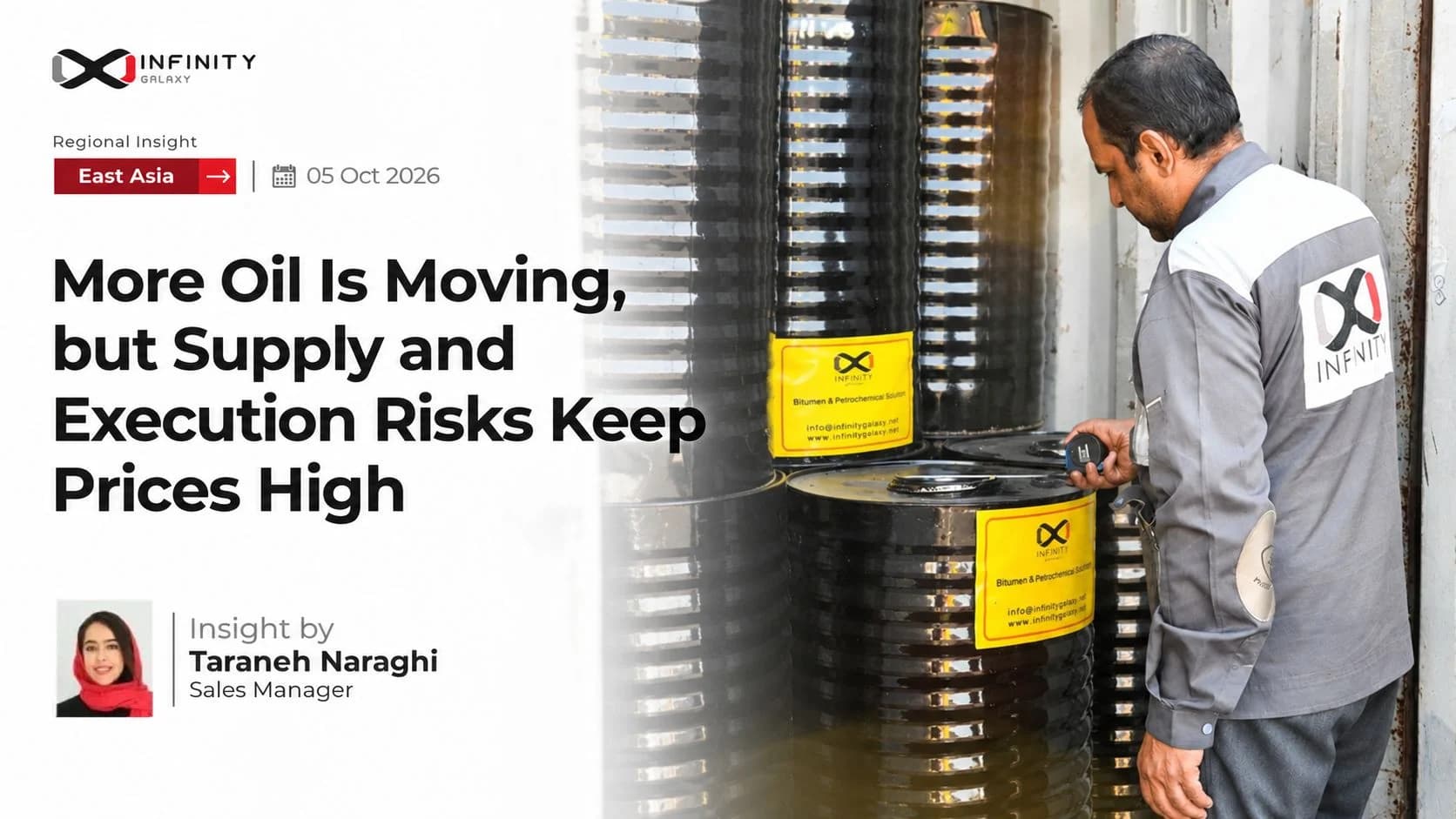
East Asian bitumen prices moved higher this week as crude remained above $100/bbl and freight, refinery feedstock and Gulf-route risks continued to support costs. Tight availability of suitable feedstock is also keeping supply from key origins including Singapore, Thailand and South Korea constrained.
However, higher offers are facing affordability resistance. Buyers remain active mainly against firm requirements, with cargo availability, loading windows and delivery reliability increasingly determining deal decisions.
The price gap between major origins has narrowed further, reducing the availability of a clear low-cost alternative. Buyers are increasingly comparing delivered economics rather than headline FOB levels.
Singapore | Tight availability supports higher offers
Singapore remained the regional benchmark, with October availability limited and firm offers scarce. FOB Singapore was assessed around $825–835/mt.
Buyers from Vietnam and Indonesia remained present, although budget constraints limited their ability to chase higher offers. Prompt and project-driven requirements can still support transactions at elevated levels, but broader buying interest remains price-sensitive.
With availability becoming the main constraint, buyers are increasingly prioritising confirmation of firm cargo and loading windows before negotiating price.
Malaysia | Moderate demand, rising supply concerns
Malaysian demand remained moderate. Some year-end projects continue to generate buying interest, while less urgent requirements have been deferred amid elevated prices.
Domestic supply remains preferred where competitively priced. However, tighter Singapore allocations and expectations of lower domestic production next month are increasing concerns over availability.
The market remains relatively slow, but any recovery in consumption could expose supply tightness more quickly.
Indonesia | Prompt requirements support buying interest
Seaborne availability into Indonesia remained limited, keeping buyers with immediate requirements in the market.
November-loading Singapore-origin cargo attracted buying indications around $825–830/mt FOB, although some budget-sensitive buyers continued to target levels close to $800/mt CFR.
The market remains divided between buyers willing to pay for reliable supply and those waiting for firmer project requirements or budget approval.
Thailand | Export availability remains constrained
Heavy rainfall and flooding continued to weigh on domestic road activity, but weaker local demand has not translated into additional export availability.
Limited refinery feedstock continues to restrict export supply. October-loading material was indicated around $815–830/mt FOB Thailand, with some selling ideas reaching around $840/mt.
Thailand remains a key regional origin, but its previous price advantage has narrowed. Buyers are increasingly seeking confirmation of availability before engaging on price.
Vietnam | Buyers widen origin options
Southern Vietnam demand remained subdued amid adverse weather, while northern demand showed some improvement as year-end project deadlines approach.
Singapore-origin buying indications were around $870/mt CFR South Vietnam. Importers were also comparing South China, Malaysia, Thailand and Taiwan cargoes.
The widening origin basket highlights the importance of delivered economics and arrival timing, rather than FOB price alone.
South Korea | Price advantage continues to erode
South Korean export prices moved higher, with FOB levels around $809–821/mt.
October availability remained limited, while East China continued to provide a key outlet. Golden Week temporarily reduced Chinese buying activity, but demand is expected to recover following the holiday.
South Korea is no longer an obvious low-cost alternative to Singapore. Grade, freight and delivery timing are becoming increasingly important in determining its competitiveness.
China | Post-holiday demand in focus
Golden Week temporarily slowed buying activity, but market participants expect demand to improve in the second half of October.
East China import buying indications rose to around $860–865/mt CFR, while October availability from South China was largely committed and November cargoes gained attention.
Tight supply is narrowing South China’s traditional price advantage against Singapore and South Korea, making origin selection increasingly dependent on delivered economics.
CIS & Central Asia | Land demand remains active; China rail flow gains visibility
Central Asian demand remained active, with Iranian bitumen in one-ton jumbo bags from Tabriz, Tehran and Arak offered around $365–370/mt ex-works.
Rail cargoes from the CIS region were also reported sold into China, indicating that CIS-to-China rail flows are becoming an increasingly relevant part of the regional trade structure.
For Central Asian buyers, ex-works price is only one component of the equation. Border timing, rail availability and delivery reliability are becoming increasingly important.
Infinity Galaxy can supply Iranian and Iraqi bitumen to CIS and Central Asian markets in 1-mt jumbo bags inside steel cages, with logistics arranged according to destination and required delivery schedule.
Rail to China | CIS flow confirmed, Iranian origin unconfirmed
Market information this week indicates that some rail cargoes from the CIS region have been sold into China.
However, there is currently no direct indication that these cargoes originated from Tehran or Isfahan. Iranian transactions reported from Tehran and Isfahan were identified as truck cargoes and should not be classified as rail-to-China sales without further confirmation.
Accordingly, the current market view supports the existence of a CIS-to-China rail flow, but does not establish Tehran or Isfahan as the origin of those shipments.
East Asia Market Insight by Taraneh Naraghi
The East Asian market is increasingly shifting from a price-driven to an execution-driven market.
Tight supply continues to push offers higher, but the bigger change is that buyers are losing access to a clear low-cost origin.
Singapore remains tight and expensive.
Thailand has limited export availability.
South Korea has lost much of its previous price advantage.
Malaysia is seeing increasing supply concerns despite moderate demand.
Indonesia continues to buy against prompt requirements.
Vietnam is widening its origin options.
China could provide renewed demand following the holiday.
Meanwhile, CIS-to-China rail flows are becoming a more visible alternative trade route.
In the current environment, the lowest nominal offer does not necessarily represent the most competitive cargo. Origin, grade, availability, loading window, freight, route and execution reliability are increasingly determining whether an offer is commercially workable.
The market is therefore becoming less about “Who is cheapest?” and more about “Who can deliver the right cargo, at the right time, with the lowest execution risk?”
Comments
Share your thoughts...
More Reports
Curious to see more, discover more articles, and stay up-to-date?